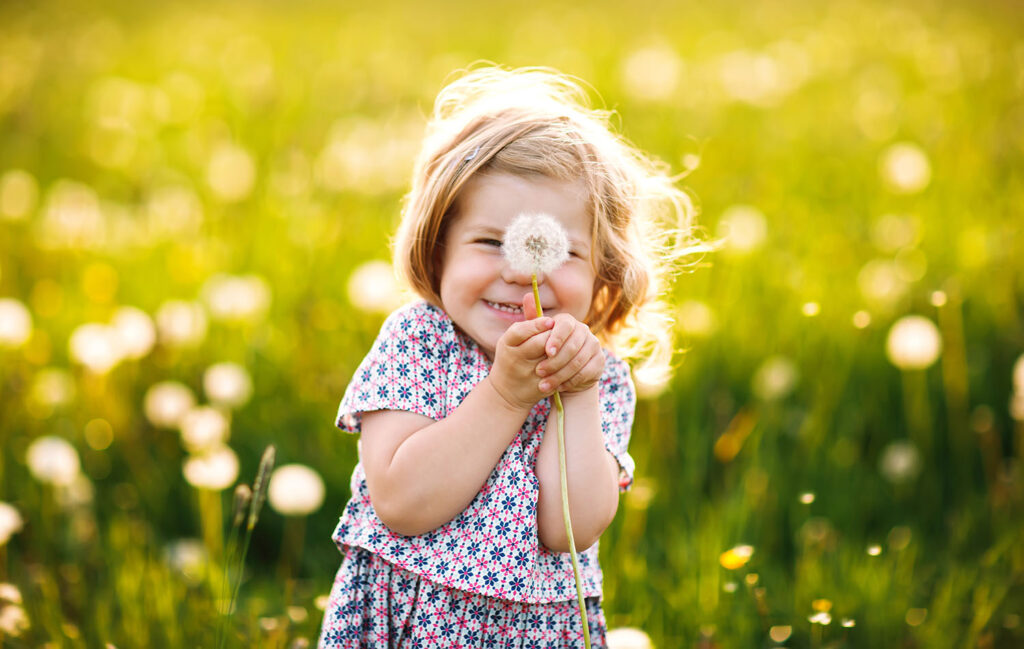
In our early years dandelions bring us joy, mischievousness and wonder. Can we recapture those feelings and add gratitude as adults? Credit: Adobe Stock
By Alliance Communications Coordinator Amy Durr
Every spring, the audacious dandelions return. And every spring, millions of Americans declare war on them – paying TruGreen billions to poison them and hauling out hand-pullers – determined to reclaim the perfect, uniform, chemical-green lawn that has somehow become the measure of responsible homeownership/
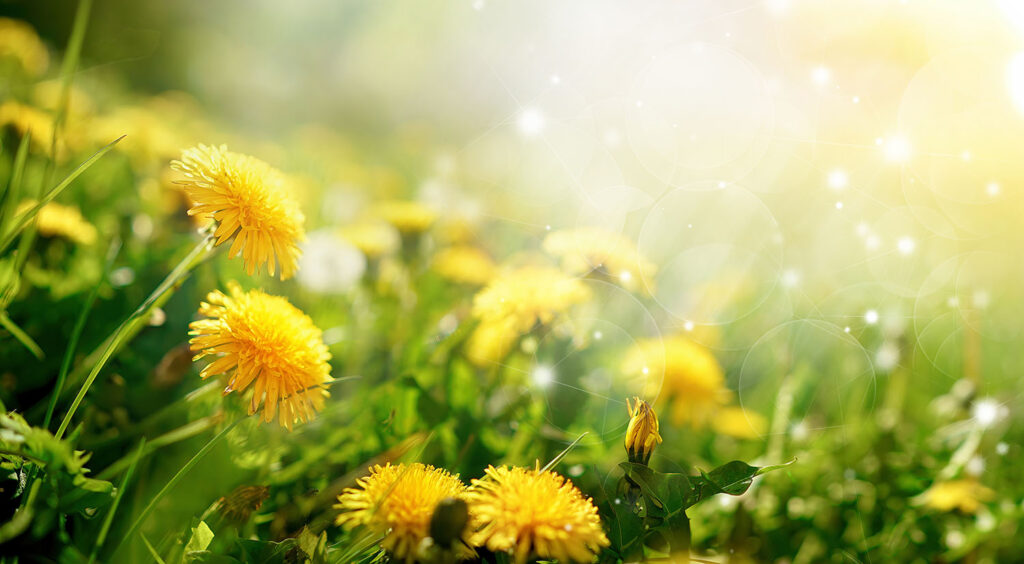
Most of us have been taught to see the dandelion as a failure: a sign of neglect, of disorder, of nature getting the upper hand. But in my yard, I practice a different kind of looking. The dandelion is not a weed that wandered into the garden uninvited. It’s a first responder.
It blooms when almost nothing else will, feeding the bees before the rest of the garden has even remembered it’s spring. It asks nothing and gives generously. The dandelion doesn’t have a branding problem. It has a perception problem — and this spring, we’d like to help fix that.
What Toddlers Already Know
Take any toddler to a dandelion-filled stretch of grass and they will run into it like they have found the Garden of Eden, Narnia and Willy Wonka’s factory all rolled into one. They will pick the flowers and blow the seeds and put one in your hair. When children look at dandelions they see beautiful bright yellow flowers which look to me like small marigolds. In fact, they kind of are.
Dandelions produce up to 20,000 parachute-like seeds per plant, which can travel up to 5 miles. Credit: Adobe Stock
The dandelion (Taraxacum officinale) is a member of the sprawling Asteraceae family of plants, which includes some of the most highly-prized garden flowers – chrysanthemums, dahlias, marigolds, zinnias, coneflowers and daisies. How is it that we were taught to hate them?
Did you know the dandelion didn’t sneak in uninvited? European settlers planted it deliberately in their kitchen gardens as a potherb and tonic. Women grew it because they trusted it, because it healed, because it tasted of home. Then tastes changed, pharmacies replaced kitchen herbalism, and the dandelion, still doing everything it always did, became a weed. The plant didn’t change. Our attention did.
Much Maligned Dandelions Are Officially Superstars
The dandelion plant is an all-purpose superhero, valued by foragers, herbalists, gardeners and environmentalists:
Eat It
Toss the young spring leaves into salads or sauté them as a vegetable — they’re high in vitamins A, C, E, and K, calcium and iron
Scatter the flowers over a salad for a bright pop of yellow, or batter and fry them
Roast or dry the taproots as a coffee substitute, or eat them as a vegetable
Ferment the flowers into dandelion wine — a tradition as old as the plant’s arrival here
Grow with It
Blooms earlier than almost anything else in spring, providing crucial nectar for bees and butterflies before the rest of the garden wakes up and they have no other feed sources
Attracts beneficial insects that prey on garden pests, such as ladybugs, lacewings, and parasitic wasps
Breaks up compacted soil with deep taproots and act as dynamic accumulators, drawing nutrients like calcium to the surface for neighboring plants
Heal with It
Dry the leaves, roots, or flowers for teas and tinctures, something our ancestors knew and used long before big pharma started selling expensive “remedies”
We get it. Not everyone has understanding neighbors. If you’re facing social pressure to keep your dandelions in check, here are some gentler approaches than reaching for the herbicides.
The simplest method is also the most satisfying: pick them. Pull them before they go to seed, eat the greens, and you’ve solved two problems at once. If you have a toddler or two around the house you won’t even have to do any work.
For prevention, corn gluten meal is a natural, non-toxic option worth knowing about. Made from corn, it prevents dandelions and over 25 other broadleaf weeds from germinating, and doubles as a slow-release lawn fertilizer, safe for kids and pets. Apply in early spring before the dandelions emerge. Just know it won’t affect plants already established — it stops seeds, not survivors.
Project Dandelion at the Skoll World Forum: In partnership with the Skoll Foundation, we are convening a women-led delegation of Global South leaders whose work is driving real-world solutions across climate adaptation, health, conservation, food systems, and girls’ education. Credit: Skoll Foundation
The Dandelion as a Symbol of Resistance
The dandelion’s reputation for spreading — those hundreds of seeds carried on the wind — turns out to be exactly the right metaphor for women-led climate action. This April, Project Dandelion returns to the Skoll World Forum in Oxford, convening a delegation of Global South women leaders working across climate adaptation, food systems, conservation and girls’ education.
They chose the dandelion deliberately: each seed represents a leader shifting systems, influencing policy, mobilizing communities. “Using the symbol of the dandelion to support collectivism,” the project aims to turn proximity into shared understanding, and shared understanding into action.
The dandelion, it seems, has always known something we’re only beginning to rediscover — that spreading widely, rooting deeply and feeding what’s around you is not a nuisance. It’s a sustainability solution.