By Alliance Communications Coordinator Amy Durr
Is there a way out from the toxic rhetoric on both sides of deeply divided America? I’d like to share what I have learned from my own experiences loving someone who struggles with alcoholism, as well as insights from high school debating teams and the NPR program Open to Debate.
Insights from Inside Addiction: Letting Go and Discovering New Possibilities
Loving someone who struggles with alcoholism will teach you things about yourself you didn’t ask to learn.
For years I held onto the idea of minimizing trauma and codependency — valid frameworks, both of them — and found that they weren’t helping me find a way forward with my former spouse. What I needed, without knowing it, was a different door.
Then I read a quote by Dr. Gabor Maté: “Addiction is not a choice anybody makes; it’s not a moral failure. It’s not an ethical lapse. It’s a response to human suffering.” I let out a breath I didn’t know I’d been holding. Not because the problem was solved, but because my assumptions had cracked open just enough to let something else in.
What does it feel like when a new idea begins shifting the ground beneath your feet? You can panic like someone stumbling into quicksand. Or you can become curious about it as an unburdening — the particular relief of releasing a story that wasn’t serving you.
That’s what genuine open debate can do. Not convince you. Not defeat you. Just crack something open.
What High School Debaters Can Teach Us: There Are Two Sides to Everything
Imagine this in our polarized world: it’s possible to have a genuine, respectful debate where both sides can win regardless of the score. There are groups of high school students on debate teams across the country who are doing this every day. What can we learn from them?
Whatever the issue, every debater has to learn and be able to present both sides of the topic, regardless of their personal opinion. Each learns to argue cogent points, whether they agree or not with them. It forces every debater to have a much better understanding of all the facts.
The beauty of the process is that they have to deeply engage and expand their own worldview. It gives them the freedom to choose which they prefer while knowing there’s an equally good counter perspective.
Maybe our lawmakers on both sides of the aisle should have to switch sides in their debates! Perhaps their harsh judgments of the other might be softened a little bit, while creating more civil dialogue.
Open to Debate: Proof We Can Modify Our Positions with New Information
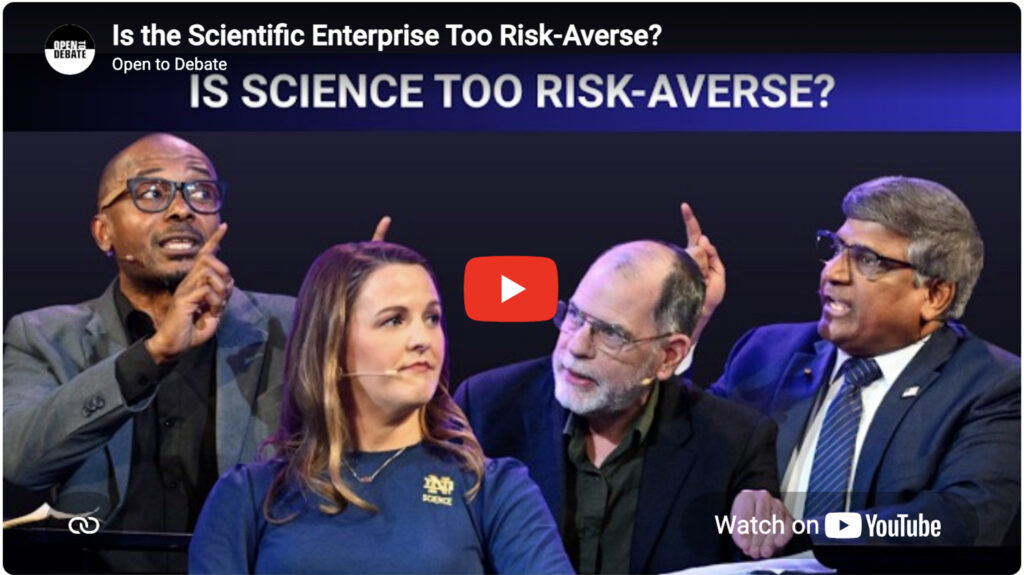
Fortunately, public radio has a weekly program offering all of us the possibility of widening our perspectives and creating a more civil society.Open to Debate began more than twenty years ago with a simple, almost countercultural premise: Americans can still change their minds.
Its mission is to “strengthen our democracy through real debate—replacing polarization with dialogue, outrage with curiosity, and noise with reason.”
Modeled on the Oxford Union debate tradition, it takes genuinely contested, controversial issues — immigration, nuclear energy, cancel culture in art, the future of democracy — with expert advocates presenting the strongest possible case for each side. They have to engage with each other’s actual arguments rather than talk past them.
Better yet, they don’t get to just stick to their debate talking points, as the audience gets to probe them. Almost always they’re asked what good points the other side made.
No slogans. No grandstanding. Just two sides making their best case, in front of an audience that votes before and after, with the winner determined by which side brought the most change to their side, not which was most popular. The results are often quite surprising as unpopular perspectives can win with effective presentations.
The impact of the show has been quietly remarkable: roughly 25 – 30% of audience members change their position — not because they were pressured or shamed into it, but because they heard a good argument they hadn’t encountered before.
In a March episode, Open to Debate’s founder Robert Rosencranz was interviewed by its original host John Donovan, from the days it was called Intelligence Squared US. Rosencranz shared the about the show’s origin:
“I felt, and this was more than 20 years ago, that the state of public discourse in America was kind of dismal. People on the right couldn’t talk to people on the left…And while there were very thoughtful organizations, think tanks on both the center-right and center-left, they were preaching to the choir. I wanted to bring something to the public square in America, something that would be an antidote to that.”
One of the debates they did last year on the anniversary of October 7 events in Israel was “Israel’s actions in Gaza were justified,” and that had 4 or 5 million downloads.
John Donovan reflected on the common response of many audience members, “Well, I didn’t really change my mind but I definitely learned something I didn’t know before.”
Today Open to Debate is a weekly program on public radio with a popular podcast and Substack, free and available to anyone who wants to practice the increasingly rare art of listening to the other side.
Changing Your Mind Can Feel Like Relief
There’s a particular stubbornness that masquerades as integrity. We call it standing by our convictions, and we’ve been taught to admire it. In polarized moments, changing your mind can feel like surrender.
The shift Open to Debate audience members feel afterwards isn’t embarrassment. It’s something closer to exhilaration — the particular lightness of a mind that just got bigger. Loosening your grip on certainty can feel less like losing and more like relief.
A Caricature Is Easier to Hate
Open to Debate has a simple rule: bring arguments, not slogans. Engage what the other side is actually saying — not the caricature, not the worst version, but the real thing. It sounds obvious. It’s almost never what we do.
Most of us have been trained, by algorithms, outrage, and the comfort of our own circles, to argue with abstractions rather than people. And abstractions are very easy to hate.
Holding our positions lightly — not abandoning them, but loosening the grip — turns out to be both a contemplative practice and a civic one. Buddhist teacher Kaira Jewel Lingo puts it this way:
Facing the truth of impermanence actually frees us up to live our lives more deeply and to transform our deepest fears. Our fear of change and resistance to change are sleeping just beneath the surface; the more we can bring them into conscious awareness and make a point to look at them clearly, the less we will be controlled by them operating under the radar of awareness.
You don’t need a debate stage to try it. You need one conversation where you stay curious just a little longer than is comfortable.
A Window Where You Expected a Wall
There’s a moment — if you’ve ever experienced it — when something someone says lands differently than you expected. Not as a threat. Just as a thing you hadn’t considered. A window where you expected a wall.
It doesn’t announce itself. It’s quieter than that. A slight shift in the chest. Something loosening.
This is what Open to Debate‘s audience members describe when they talk about changing their minds. Not conquest. Not humiliation. Something that feels, unexpectedly, like expansion — like setting down a bag you’d forgotten you were carrying.
Most of us are not as certain as we pretend to be. Somewhere beneath the talking points, there is a person who suspects the world is more complicated than any single position can hold.
A Crack in Something Sealed
I didn’t go looking for a reframe when I read Gabor Maté’s words about addiction. I went looking for a way to stop being so tired. What I found instead was a crack in something I hadn’t known was sealed — a small, unexpected opening that let a little more truth in.
My story’s not a political story. But the potential for transformation is the same. The willingness to let a new idea land — to feel it shift something rather than deflecting it before it gets close — is the same muscle whether you’re rethinking your assumptions about someone you love or someone you’ve never met and already distrust.
The ground can shift beneath your feet and hold you. That’s not quicksand. That’s just what it feels like when something opens.