
By Alliance Intern Eleanor Hulan, U of MN ‘22
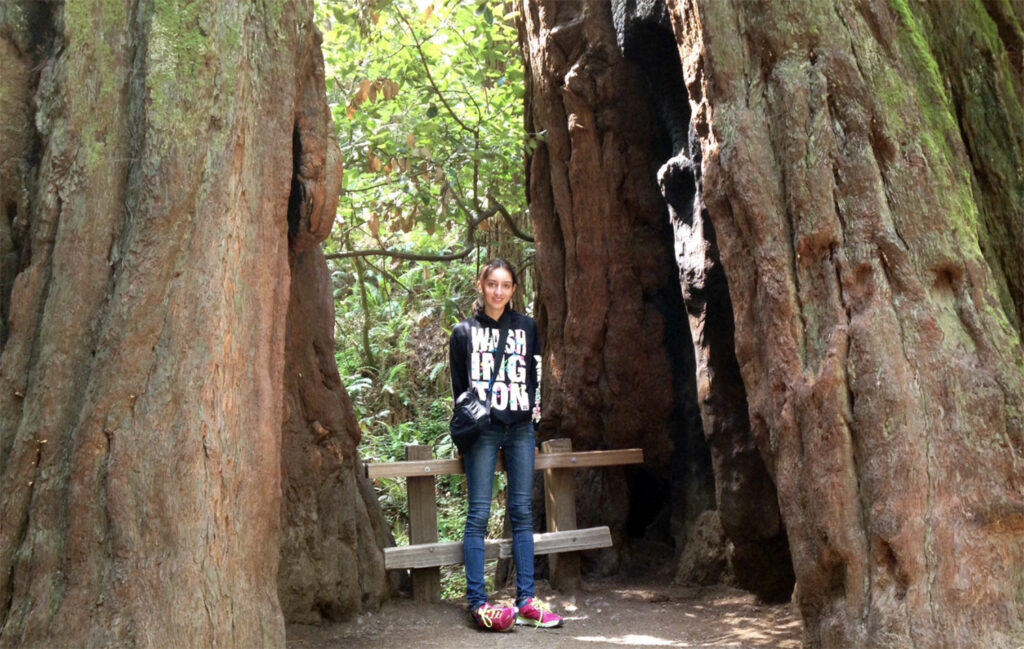
I was newly 14 and completely uncomfortable in this world. I was too tall, too awkward, too absorbed in teenage angst, and didn’t like posing for photos. I struggled to ever feel truly at ease, to find peace. In the shade of Redwood National and State Parks’ massive trees, their immensity somehow became a bulwark against anxiety and fear. I was able to capture some of their peace.
A few years later I learned about the instantly famous environmental activist Julia Butterfly Hill and the gift she has given me and millions of others by transferring feelings into effective action.
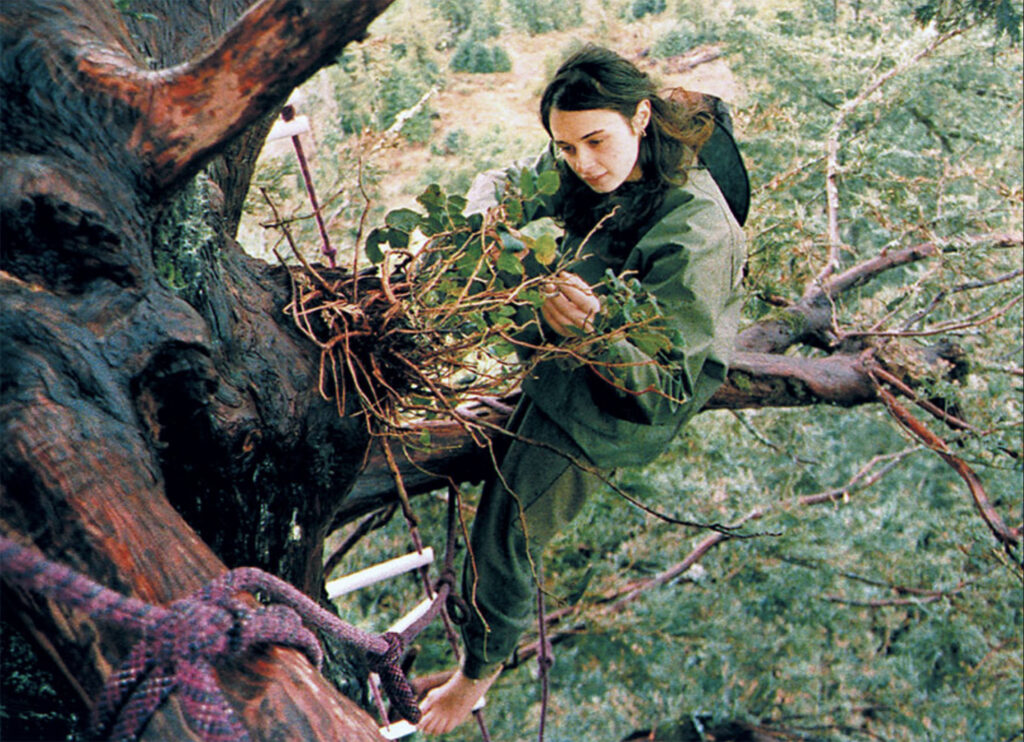
Julia was there 17 years before me. Initially only in Humboldt County, CA, firmly on the ground, to join a group of anti-logging protestors, Julia soon found herself 180 feet up in a tree she nicknamed Luna. She remained up there, living with Luna for almost two years, enduring violent storms and all the challenges of being exposed to weather extremes. What drives someone to the top of a tree, and what keeps them there?
As Julia shared, “While I was in Luna, I learned that every issue we’re facing is the symptom, and the disease is the disease of disconnect. When we’re disconnected from the Earth and we’re disconnecting from each other, we make choices and don’t realize how it’s truly impacting all of us, and that means all the beings, everything, and the future generations. I wanted to try and help weave that together for people, that if…we’re working on the symptoms, if we don’t work also at the disease, we’ll never be able to get to the healing that our world and our planet needs.”
Julia Butterfly Finds Her Calling
Roughly 17 years prior to my being in California’s Redwoods, a young woman was experiencing her own spiritual awakening in the old-growth forests. Julia Butterfly Hill was raised Evangelical, her father a minister who homeschooled the family. She no longer practices a religion in the traditional sense, but I believe that in Luna, the 200 foot tall tree Julia Butterfly Hill lived in for 738 days, the activist developed her own sense of the Divine.
“The loss of nature is the loss of the sacred.” — Julia Butterfly Hill
After a near-death experience in a 1996 car accident, which led to a year of grueling rehabilitation, Julia, at 23 years old, went west to find her purpose, and perhaps her own peace. In an extraordinary act of civil disobedience, she ascended Luna in Stafford, CA on December 10, 1997, fueled by the imminent threat of Maxxam Pacific Lumber Company to clear-cut all the surrounding 1,000-year-old forest.
This forestry practice of total logging and deforestation wreaks havoc on biodiversity, leads to erosion and flooding, and destroys ecosystems that can never be replaced. Sadly, clear-cutting is still very much in use today. While most of us focus on the Redwoods themselves, too few of us think about the entire ecosystem and its inhabitants that play so many critical roles in protecting our health and limiting climate change.
The Importance of an Old Growth Forest Ecosystem for Combatting Climate Change
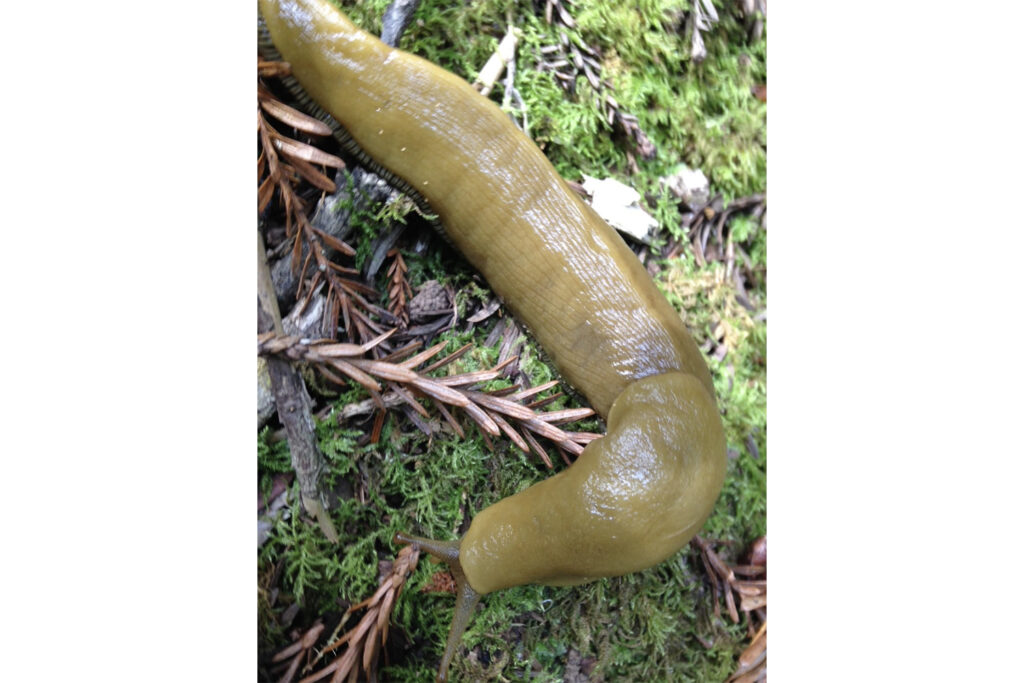
Delighted with a banana slug?! Among the images I captured on my 2014 trip to the Redwood National and State Parks, I found only two pictures of me, several of the redwoods themselves, and 26 of glistening, embryonic yellow-green banana slugs in the undergrowth. I was delighted by them, probably because, unlike most other animal life, they allowed themselves to be observed, bulky and shockingly large but still incredibly vulnerable.
I now know these creatures play an essential role in the forests of California, and soil rich environments in general. Detritovores are ecosystem engineers that aid in nutrient cycling and creating new, healthy soil, an integral part of carbon sequestration. Worldwide, soil holds 2,500 gigatons of carbon, more than is stored in terrestrial plants or the atmosphere, combined. Banana slugs should be our best friends.
Julia Gains Support While Enduring Dangers from Logging Companies and Nature
She was soon backed by Earth First! and later, by Sanctuary Forest, which remains the steward of Luna to this day. Julia endured storms, smoke inhalation from Maxxam’s continued burning, plus intimidation from company representatives.
In speaking about the 1998 El Niño weather system she and Luna experienced, Julia said, “One night, the wind blew me three feet sideways with every gust. I only made it because I emulated the branches that survived – by yielding to the wind.”
She often navigated barefoot in order to better adhere to the branches, and abandoned safety devices like ropes and harnesses two weeks in.
A Victory at Trees – Luna and the Surrounding Redwoods Are Saved
Although protests against loggers in the Headwaters Forest area had been occurring since 1990, Julia brought international attention to the ‘tree-huggers’ and eventually achieved enduring protection for Luna and the surrounding Redwoods with a conservation easement. It was an astounding accomplishment.
The Luna Covenant Agreement with the Maxxam Pacific Lumber Company is enforced by Sanctuary Forest. Incredibly, it remains to this day. In 2000, after Luna was intentionally gouged at the base with a chainsaw, Sanctuary Forest collaborated with Maxxam and the California Department of Forestry to save her, installing cables to prop her up and keeping close watch.
In a 2021 interview with Kerry Reynolds of the Trees Foundation, Julia said “I started telling people — it’s still true for me today — that if you’re not angry at the world, you’re not awake. But do we choose to do what we do out of our anger, or do we choose to do what we do out of our love?”
Can We Experience Julia’s Awe and Connection Without Climbing Luna?
How can we impart this profundity, this love, this amazement at the awesome spectacle that is a tree standing for a millennium, a rising moon (the origin of Luna’s nickname), and for me, a shockingly bright gastropod in the dirt? There are people who do not feel the same connection with the sacrosanctity of nature Julia does, and certainly people whose convictions do not extend to the taxing work of strapping on a harness and climbing 180 feet into the sky.
Luckily, at least some degree of this connection seems innate. Attribute this to design, to self preservation, to the feel of fresh air or the symmetry in nature we see mirrored back at us, but the majority of us humans do sense the bond. 84% of Americans say they like or love spending time in nature, 72% say it is necessary.
The World Wildlife Fund, in a 2025 report, also found that 84% of Americans are concerned about threats to nature. As I see regulations being rolled back and climate change denial coming back into vogue, it is heartening to also see that the majority of us still want to preserve the beauty of our natural world.
The New Generation
The legacy of young women climate activists like Julia continues, perhaps most notably with Greta Thunberg, who began the climate strikes among schoolchildren and has never given up her fight. I would argue standing strong against the vitriol Greta has faced from climate deniers may be just as taxing as clinging to Julia’s platform amidst 40 mph wind gusts.
These inspiring female activists have helped me as I’ve dealt with my own issues. One of the hallmarks of my adolescent malaise was the feeling that nobody had ever felt the way I did. My loneliness, sorrows and anger felt unique. Certainly, my experiences were distinctive in some ways, but part of growing up is realizing just how much these feelings are shared by most people.
Julia, who I learned about a few years after my experience in the CA Redwoods, was a contributor to this revelation. Many of her sentiments towards the human connection with nature mirrored my own. Like me, Julia was a young woman who had deep feelings about nature. The fact that she acted on those feelings and did something truly extraordinary still is both comforting and exhilarating.
Julia’s words probably best summarize my own hopes and her lasting legacy:
“We cannot control the world, unfortunately. But what we can control is how we choose to show up to the woundedness, how we choose to show up to the overwhelm, how we choose to show up even when we’re angry, how we choose to transform that anger into love, and find a way to heal.” – Julia Butterfly Hill
Really excellent piece, so well-written and inspiring!