
By Eleanor Hulan, Alliance for Sustainability Intern
As AI usage has skyrocketed, so has the building of data centers, overwhelming local governments and their ability to regulate them. There are more than 1,300 data centers operating in the US today, according to Cleanview. An additional 2,231 data center projects are planned or in development. About 100 facilities already in operation are classified as massive “hyperscale data centers” that consume at least 100 megawatts of power at peak capacity, according to Cleanview.
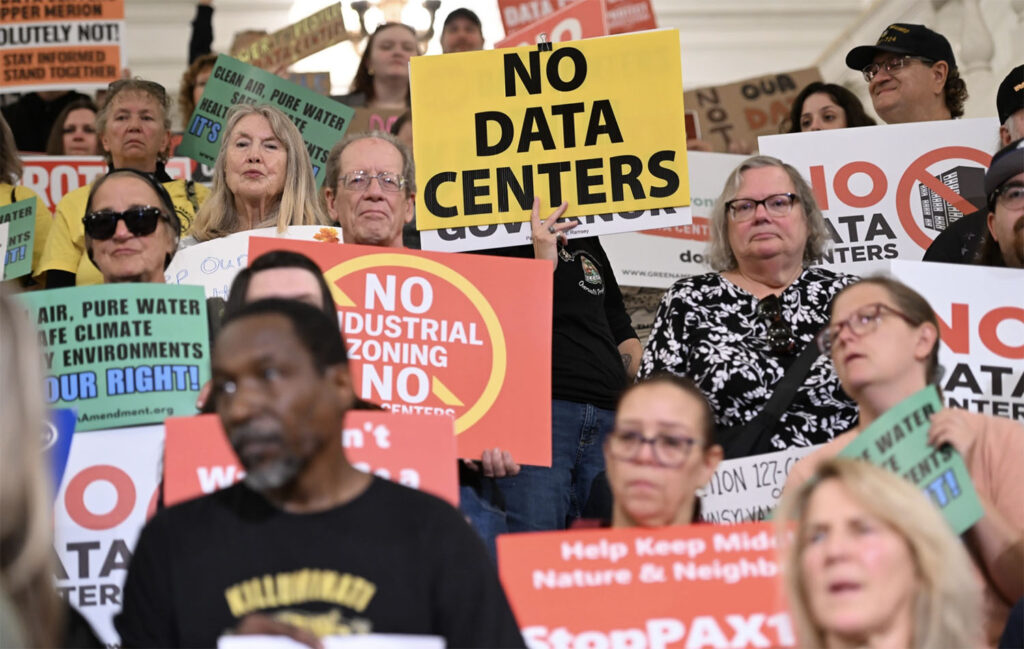
Protest movements are growing at the same rate, creating an odd couple relationship between rural MAGAs and environmentalists. These protests have forced both Democratic and Republican governors – like J.B. Pritzker in Illinois and Greg Abbott in Texas – to pull back their full-throttled endorsements. There are roughly 400 moratoriums and bans already enacted by communities over concerns that data centers are a drain on electricity, water and land.
However, it’s clear AI seems to be here to stay, but with the election results will there be a moratorium or adequate regulation affecting everything from siting and open public decision-making processes to energy and water demands?
Data Centers Have Existed for Years, but Never at This Magnitude
Many people don’t realize data centers are not new. They’ve been around since computer technology began, and ultimately they serve the same role they always have: saving digital information. They host software, power equipment and support infrastructure.
Before the AI boom, Google, Meta, and Amazon were some of the first constructors of what were known as “hyperscale” data centers – larger, more efficient, and uniquely designed. These are distinguished from smaller, more localized ones that have been around a long time.
In 2024, “AI data centers” became their own class. They don’t require completely different equipment or serve a fundamentally different purpose. The main differences are overall capacity, networking equipment that processes data more quickly, higher power requirements, and, notably, immersion cooling systems to disperse the large amounts of heat continuous AI workloads put out.
It’s important to point out that these massive or “hyperscale data centers” – accommodating more than a hundred thousand servers in some cases – are used for AI, as well as crypto and other data processing. They existed before modern AI debuted. What’s happened is that “AI has made large-scale data centers more important because AI workloads require vast infrastructures, but it’s not as if no one was building large data centers before AI rose to prominence,” according to Data Center Knowledge.
Americans Don’t Like Data Centers
AI data centers are unpopular. Polls show 71% of Americans would oppose one being built in their locale, more than oppose a nuclear power plant. In fact, Americans would rather live near a prison or a methadone clinic than an AI data center, according to comparative polling.
A POLITICO Poll showed Americans are now more likely to oppose candidates who are pro-data center construction. The opposition bleeds across party lines, with 36% of Republican and 65% of Democratic midterm voters saying they would oppose or strongly oppose a data center being built within 3 miles of their home.
Cited concerns include water shortages, energy costs, noise and light pollution, environmental injustice, loss of farm land and decreased property values.
There are so many examples of clear threats across the country. Elon Musk’s hyperscale data center in a historically Black community in Memphis is causing massive air pollution from its natural gas turbines, and equally large environmental justice protests. A proposed center in a Palm Beach area abutting the Everglades, which would damage wetlands and cause significant harm to the area’s watershed – an area already supremely stressed by climate change.
This May in Utah, swift opposition to the construction of an AI data center that had already been approved by the city commission led state officials to walk back the pace of the project. 7 out of 10 voters, across party lines, said the alleged economic benefits were not worth the water and energy costs.
The bipartisan backlash to the construction of data centers is pushing some voters left. One study showed that the percentage change since May of citizens planning to vote blue in the midterms is three times higher for voters living near (less than 2km away from) a data center than those farther away.
Trump’s Unrestrained Support for AI and Data Centers
President Donald Trump has continued his opposition to regulation of hyperscale data centers, saying the large hubs bring jobs and tax revenue to communities that embrace them. He’s also argued that any halt in construction would give China an edge in the AI development race.
He has posted such phrases as, “The only reason that communities throughout the U.S.A. should not want Data Centers is if they want to end up being backwards and poor.” It’s comments like these that have fueled opposition to data centers.
In October Trump drew the link between data centers and AI saying, artificial intelligence should be called “SI” for “super intelligence.” He lambasted media channels for not referring to it as such, adding that the word “AI” would be banned from federal documents.
Measures Have Been Taken and Promises Have Been Made By Both Sides
In the past few months, we have seen proposed moratoriums or other restrictions all over the news, with Democratic incumbents and hopefuls having been more likely than their Republican counterparts to condemn data center construction. However, as the bipartisan nature of data center concerns has become clear, some Republicans have also diverged from the MAGA line.
- Kathy Hochul (D), Governor of New York, signed a one year suspension on construction in July, halting the initial stages of development for proposed centers in a state with ever-increasing demand. The bill in its previous form instead called for three years.
- Kelly Ayotte (R), Governor of New Hampshire, declared herself against “putting any data center in the state of New Hampshire” after news broke about a proposed center. No executive order has gone into effect, however.
- JB Pritzker (D), Governor of Illinois, paused tax incentives for data center construction, which does not preclude their being built. From 2019 to 2024, Illinois approved tax incentives for 27 data center developers, out of 28 who applied.
- Greg Abbott (R), Governor of Texas, has tried to straddle a politically-advantageous line. He has spoken about eliminating tax breaks and having centers provide their own power, but would like to continue with his business-friendly brand.
- Josh Shapiro (D), Governor of Pennsylvania, originally boosted data center subsidies but has since reversed course and introduced a plethora of restrictions on data centers over the summer.
- Democratic challengers in Nevada, Colorado, and Ohio all made stalling AI data center construction part of their platforms.
Despite the Protests and Pull-Backs, Data Centers Continue to Grow
The 2026 Data Center Report shows year-to-date data center spending in 2026 has far surpassed the year prior. 2026 spending is on pace to hit $121 billion, compared with around $40 billion in 2025.
Regarding bans and delays, Maya Barkin found that only about 2.3 gigawatts worth of projects may be affected by moratoriums. To put this in perspective, one AI data center uses approximately 1 GW of energy, and proposed constructions number in the hundreds.
In a notable exception to the past year’s trends, Maine’s democratic governor Janet Mills vetoed a proposed moratorium, citing business concerns. My guess as to why she felt confident doing so? She’s not up for reelection.
Midterm Elections Are a Stunning Rebuke for Data Centers
While Trump may continue to be a data center booster, the American people have now spoken in opposition as existential concerns about AI have grown, according to Time. The midterm elections put data centers on the ballot across the nation, and Americans had a resounding answer: Not in my community.
An NBC exit poll found 56% of voters said AI and data centers were a “crucial or major factor” in their vote for Congress. “Democrats spent more than $100 million on broadcast ads casting their Republican opponents as being overly cozy with Big Tech and data centers — and decisively won in many of those races, including Ohio, Kansas, and Iowa,” according to Time.
“Roughly 40 cities and towns across the nation weighed measures to restrict data center development. At least 33 voted in favor of reining in the industry, supporting moratoriums, new regulations and outright bans, according to Data Centers on the Ballot. Only one town in North Dakota voted against restrictions,” according to USA Today.
They added, “Many candidates who were tough on data centers succeeded, while notable data center supporters failed. The trend backs what polling has indicated for the last year: Data centers have become a political liability capable of impacting elections and bridging deep political divides.”
Predictions Show Reductions in Data Center Development Due to Election Results
Elections have consequences, in this case good ones for opposition to data centers. According to a BMI industry forecast after the elections, “More than half of the US hyperscale data center pipeline could face heightened regulatory friction following the 2026 midterm elections,” highlights Data Center Dynamics.
But BMI predicts, “This is likely to take the form of political interventions, rather than a substantial policy shift, and that a broad national moratorium on new digital infrastructure projects remains unlikely.”
In a new report on the impact of the elections, BMI analysts said: “Construction schedules for 2027 are largely locked in, placing the focus on 2028 and beyond. “With respect to hyperscaler buildouts, the markets commanding the largest pipelines from 2028 onwards are likely to be Texas, Georgia, Ohio and Pennsylvania.” All four of these states have Democratic governors challenging data centers. Consequently, it is estimated “53% of pipeline growth is now exposed to slowdown risk,” according to Data Center Dynamics. It’s clear our organizing and protests are really paying off.
Writing on X, market intelligence firm Cleanview founder Michael Thomas said, “Tuesday’s results don’t signal the end of the data center boom. They will, however, likely bring a pause in some of the largest markets and new regulations across the country – even in traditionally laissez-faire states like Texas.”
He added there will likely be “more clean energy in some states and fewer on-site gas plants in others.”
He pointed out that, “On-site gas plants will likely face new rules and delays. To build an on-site gas plant, a developer needs an air permit. That approval often goes through offices controlled by the executive branch, which means new Democratic governors could delay or block those permits.” This is all fabulous news for our calls for sustainability, but will require vigilance and action at the local and state level.
In addition, Thomas points out that developers may also be forced to buy more clean energy. He cites candidates such as David Crowley, the incoming governor of Wisconsin, who has called for 100% renewable energy as a condition for approving data center projects. All of this shows the impact people have had with their protests. Power to the people!
Now, It’s Time to Enact Real Legislation and Regulations on Data Centers
Fortunately, there is positive national legislation being proposed. The Artificial Intelligence (AI) Data Center Moratorium Act, introduced by Bernie Sanders and Alexandria Ocasio-Cortez, is a good start. It’s positive that it leaves the length of a moratorium open. The moratorium will end:
“only when laws are enacted that not only prevent data centers from contributing to climate change, harming the environment, and raising electricity bills, but also prevent tech companies from producing products that harm the health and well-being of working families, privacy and civil rights, and the future of humanity.”
This is one approach to the rigorous standards that must be enacted to control this too-rapidly growing industry. Given the seismic political shift in Congress, it will be interesting to see if there will be enough support to pass such legislation.
We need to hold our elected officials’ feet to the fire to make sure their campaign soundbites and pledges aren’t just performative political noise. Even with a Democratic majority, it is ultimately still up to the people to hold their representatives accountable.
And we need to go one step further. Climate change was largely dropped as a topic this midterm cycle, but many grievances about AI data center construction are ultimately sustainability-related. Let’s continue to establish these correlations and push for leaders to assure true sustainability with AI and data centers.