
By Alliance President Terry Gips
We’re celebrating World Vegetarian Day Oct 1 and Gandhi’s birthday Oct 2 by sharing some of the highlights from author and climate activist Bill McKibben’s provocative New Yorker piece, along with some of our own thoughts.
McKibben begins: “Robert F. Kennedy, Jr., eats it every day, but more Americans, faced with rising prices and another climate warning, might want something else for dinner.”
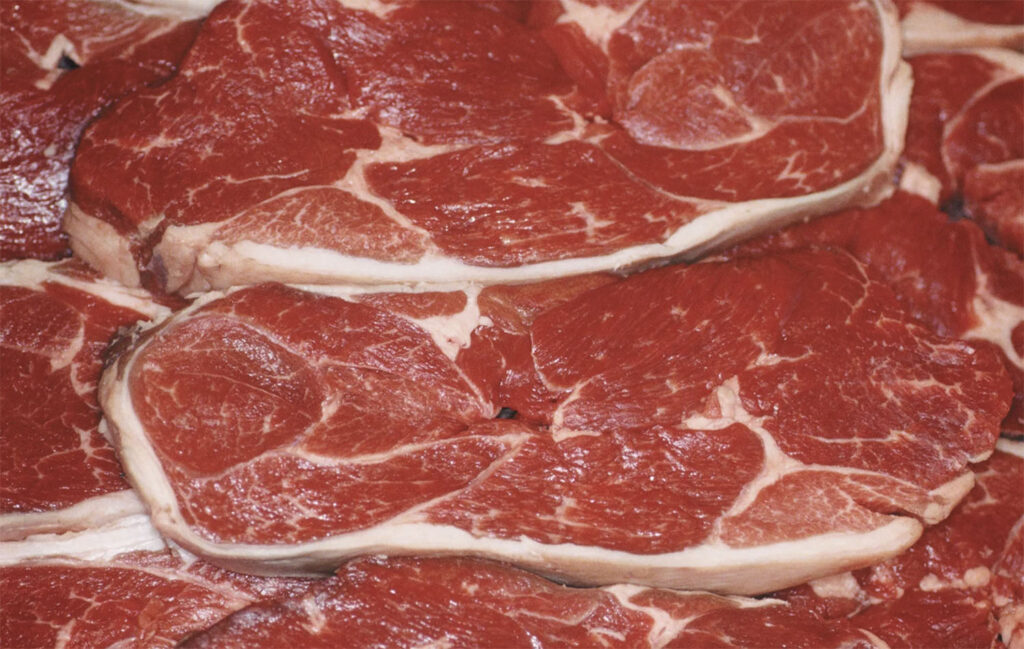
We’ve all heard the constant heavy promotions for meat, especially since the 1992 National Live Stock and Meat Board’s advertising campaign “Beef: It’s What for Dinner.” For years, the slogan seemed to work and beef sales skyrocketed. However, as time has gone on a series of setbacks – from medical research linking beef consumption with heart disease, cancer and strokes to the disclosure of climate impacts – have led to decreases in consumption.
The downward trend was continuing until McKibben points out “our nation’s chief health officer, Robert F. Kennedy, Jr., put a fatty cut of beef near the top of the newly revised, inverted food pyramid, and told an interviewer that he usually eats beef twice daily; his preferred cut is a grass-fed strip steak.”
McKibben continues, “Indeed, he said, a ‘large number’ of the President’s Cabinet is on a ‘meat and ferments’ diet, meaning that they take their prime rib with some sauerkraut on the side. Sean O’Mara, the physician who has reportedly been advising several of these leaders on their diets, explained to the Times that eating this way eliminates the need to wipe after defecating, and that on such a diet bowel movements become ‘nearly orgasmic.’”
What?! Is this lunacy? Any doctor will tell you that high meat diets without a significant amount of fiber from vegetables will leave you constipated, so it’s hard to imagine what’s so “orgasmic” about that.
But setting such bizarre claims aside, this may in fact be a golden opportunity to reconsider our dietary choices. McKibben points out that, “There seems at least a chance that this moment might also be the high-water mark for cut-up cattle. In the same way that, around the world, internal-combustion cars are suddenly, and rapidly, giving way to electric vehicles, it’s possible that a combination of technological, economic, ecological, and cultural factors might be lining up to challenge the hold of beef.”
If he’s right, I agree with him that this would be “a big deal: beef cattle use something like sixty per cent of the planet’s agricultural land, even while they provide just two per cent of its calories.”
One prime driver is “affordability,” that term which our President claims doesn’t exist. McKibben argues:
Right now, the cost of beef is soaring, with hamburger meat nearing seven dollars a pound nationally and exceeding that in many places. Part of that rise may be due to demand from legions of bro-sphere podcasters chugging down beef smoothies. (Erewhon offered one made with raw milk and “powdered” beef organs, for just nineteen dollars.)
I will give RFK Jr. credit for succeeding in boosting America’s unneeded and unhealthy preoccupation with forcing as much protein into their bodies as possible, as if they’re being fattened up just like the cattle they eat.
As an agricultural and applied economist, I appreciate McKibben’s argument that one of the factors driving up the cost is drought, especially in Great Plains states. This has limited grazing and depleted forage grasses, forcing ranchers to do early slaughter, and ultimately, reducing supply and driving up prices. In fact, McKibben shares that, “As of January, the country’s total cattle herd was smaller than it had been since 1951, three years before the birth of Burger King.”
Another key factor in the high prices are input costs for farmers, especially from diesel fuel, which hit a new record high of $6.52/gallon, driven in part by the Gulf of Hormuz blockade. McKibben points out there are other drivers as well, such as, “the screwworm fly, a flesh-eating parasite that likes to lay its eggs in the open wounds of warm-blooded animals, so that the larvae can feed off living tissue.”
The Trump Administration’s plan to combat the rise in beef prices has actually backfired. His calling for imports of cheap Argentinian beef has enraged cattlemen across the country because it’s completely devastated their already limited margins.
McKibben really goes into the belly of the beast by sharing about the corruption in the beef industry:
The President, who likes his steak well done and slathered in ketchup, met with a Brazilian beef magnate named Joesley Batista, who in the past had admitted to making large payments to public officials and was briefly jailed.
As Maggie Haberman and Jonathan Swan recount in their recent book, Regime Change, Batista met with the President after a US-based subsidiary of his company donated five million dollars to Trump’s second Inauguration…Now, just days after the European Union suspended imports of Brazilian beef for failing to meet its safety standards on antibiotics, Trump has announced that large quantities of it will be permitted to enter the United States, in hopes of lowering prices before the midterm elections.
…And they probably won’t drive the price down very much — NPR quoted a University of Tennessee professor of livestock economics who said, of a possible reduction, “I don’t think it’s going to be $1.50” less. “We might see a quarter to 35 cents.”
It will be interesting to see if McKibben is correct that just like the war in Iran caused gas prices to rise and created an opening for EV sales to rise, whether “this confluence of events might give alternatives to beef a moment of opportunity.”
What do you think? Have you cut back on your beef consumption? Let us know.
Either way, I hope you’ll consider a Meatless Monday or eliminating meat from your diet and even join me as an organic vegan. Trust me, the water’s fine over here and the food is not only delicious but will allow you to live a healthier, more vibrant life for a lot longer.