By Teri Reitan, Co-Executive Director of the Alliance for Sustainability
With the UN International Day of World Indigenous Peoples approaching (August 9), I am pausing to reflect on a wonderful friendship made with an Anywaa tribal member this past year.
In the green, river-fed lands of Gambella, where the waters of the Akobo, Alwaro, Openo (Baro), and Gilo shape both earth and memory, the Anywaa people have long lived as cultivators, fishers, and caretakers of a homeland that is far more than territory. For the Anywaa, land is memory, river is identity, and community is life itself.
Their story begins in belonging: in villages shaped by relationship, in ancestral lands honored through farming, fishing, ceremony, and kinship, and in a worldview that sees nature not as something to own, but as something to live with and protect.
A Story of Strength and Resilience
The strength of the Anywaa has never rested only in survival. It has also lived in wisdom. Their traditional institutions — the Nyieya (community council), Kwaaro (customary court), and Nyibur (spiritual leadership) — are described as the living heart of community governance, justice and spirituality.
That is a beautiful truth: the Anywaa are not merely a people who endured history, but a people who built ways of guiding it. Their culture carries order without harshness, memory without bitterness, and justice with a restorative spirit. In that, there is something profoundly dignified and deeply admirable.
Voice of Community Overcomes Hardship
The Anywaa story also includes hardship. They’ve been subject to forced displacement, environmental damage, violence, and exclusion. But even here, the most important truth is not only what has been taken from them — it is what they continue to defend with courage.
The words quoted from Anywaa leader Yousif Gilo are powerful: “Take away our rivers, our forests, our ceremonies, and you take away our being.” This is not the language of surrender. It is the language of people who know their worth. It is the voice of a community that insists its life, dignity and heritage matter.
That courage has not remained only in memory – it has taken organized form. A Cultural Survival report on Ethiopia highlights EMIPRO, founded in 2022 by Indigenous activists including Anywaa leadership, as Ethiopia’s first legally registered civil society organization dedicated to the rights of Indigenous and minority peoples.
This matters because hope becomes stronger when it gains structure. Advocacy, documentation, legal recognition, and the defense of ancestral land are all part of a future the Anywaa are helping shape for themselves. Their resilience is not passive endurance; it is active, intelligent, principled leadership.
The Cultural Magic of Music
And then there is music — that faithful keeper of identity. Research on Anywaa music in Gambella shows that songs are not only performances. They are also lessons, bridges, and vessels of remembrance.
Musical traditions such as the thoom (thumb piano) and distinctive drum rhythms like okaama and agwaa-ga are part of what many Anywaa people recognize as their own cultural sound. Just as important are the lyrics: songs that tell history, affirm cultural practice, and call people into unity. In these songs, culture is not stored in books alone – it is sung back into the heart.
That may be one of the most moving things about the Anywaa story: even when hardship comes, memory does not go silent. The research describes songs that call on Anywaa people across borders and across distance, reminding them who they are and to whom they belong.
One singer praised songs that “renew” what people may be forgetting, so that “people remember.” That image is unforgettable. A people who remember together are never truly defeated. A people who can still sing themselves back to one another carry a resilience deeper than fear.
A Celebrated Living International Culture
Yet the story of the Anywaa is no longer held only along the rivers of Gambella. It also lives in the diaspora, in Minnesota and other states within the US, where families built new lives while celebrating their culture and traditions refusing to let their identity fade.
A Minnesota church page describing the community says the Anywaa people moved to Minnesota in the early 1990s and have continued worshiping and serving together there.
Migration did not erase identity — instead, identity traveled. It was carried out in language, faith, memory, food, music and family life — and began again in a new land.
For many, Minnesota became more than a destination — it became a place of rebuilding across generations. Minnesota Public Radio reported on exiled Anuak/Anywaa in Minnesota organizing in response to violence in Ethiopia, noting that more than 8,000 Anuak fled their homes after attacks in December 2003.
Today, the presence of Anywaa parents, children, and grandchildren in the United States stands as living testimony to a people who have suffered, endured, and still chosen life, community and continuity. Their existence across generations is itself a quiet victory.
Keeping the Culture Alive for Future Generations
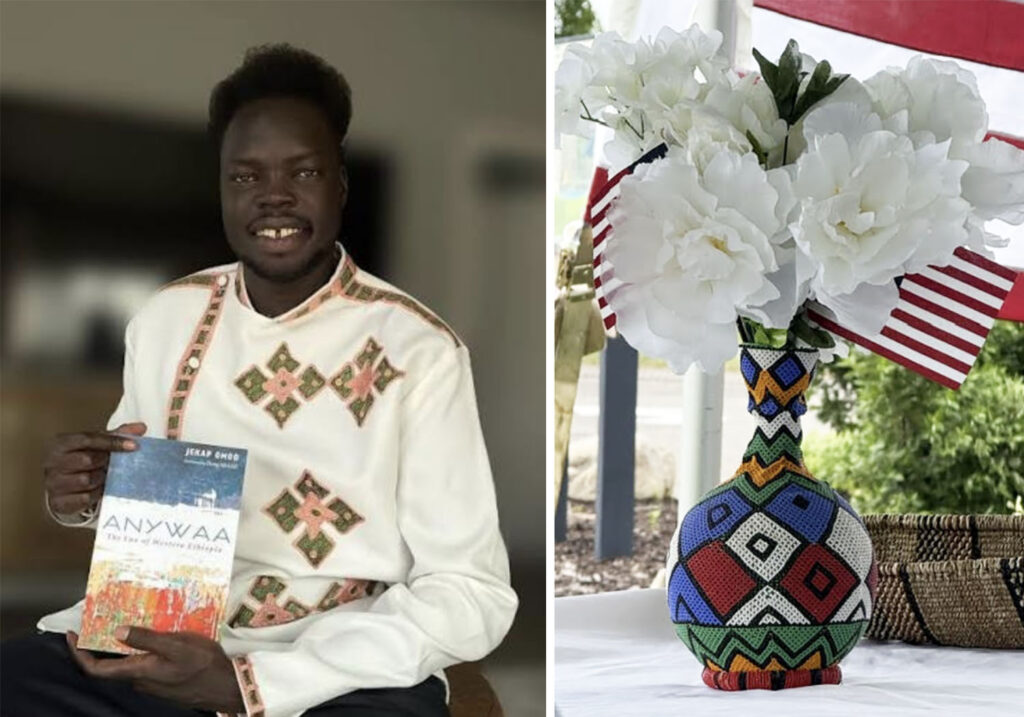
One of the most inspiring chapters in their continuing story is the effort to keep Dha-Anywaa alive through language and books. Open Hearts Big Dreams is about preserving the language. Jekap Omod, a Gambella-born writer, describes growing up with almost no non-governmental printed books in Dha-Anywaa. He has studied and is actively implementing the techniques to ensure the Anywaa culture lives on, including through language.
Omod explains that many Anywaa children in Gambella, refugee camps and the Western world still lack access to books in their mother tongue if not for this project. It is not merely literacy at work, it is also a restoration — a way for children to feel represented, valued, and proud of their language. It’s also a way for US tribal members to provide to their Gambella friends and family.
This is cultural survival in one of its most beautiful forms: when a people decide their children will inherit not silence, but words. There is something especially hopeful about bilingual books in this context. They do more than teach vocabulary. They connect generations by allowing elders, parents and children to meet one another in language.
They give young Anywaa growing up far from Gambella a way to hear the rhythm of who they are. They help ensure that Dha-Anywaa is lived as a present and future language — spoken at home, read in stories, and carried proudly by children who know that their heritage and culture belong in the literary world too.
Appreciation for the Beauty of Their Culture
It was an honor for me to meet Jekap Omod in 2025, first over the phone and then in person at an annual Anywaa cultural celebration in a Twin Cities suburb. My son, who had been in a class with Jekap the year before, had given me Jekap’s book as a gift, and I wanted to learn more about the Anywaa culture and mission.
That conversation led to the online store Anywaa Gifts, owned by Jekap and his wife. It represents a place to celebrate and share the rich heritage of the Anywaa people through artisan-crafted products crafted in Gambella.
Their items are made by skilled Anywaa artisans, and preserve traditional techniques and cultural heritage, support fair wages and promote sustainable livelihoods. The store is working to become Fair Trade Certified and further help the Anywaa art pieces to become more than decoration — in functional and ceremonial culture made tangible to share with pride.
What makes this so powerful for me is that the Anywaa are not preserving their culture as something frozen in the past. They are carrying it forward creatively. Through songs, worship, storytelling, books, craftsmanship and through community life in places far from Gambella they are proving that heritage can adapt without losing its soul.
Love and Culture Endure
The story of the Anywaa is not a fading story – it is a living one. It is the story of a river people who still know the names of their waters. It is the story of councils that still embody community, songs that still teach the young and leaders who still speak for land, dignity and memory. It is the story of families who crossed borders and still carry home within them.
The Anywaa remind the world that cultural pride is love. Their resilience is faithfulness. Survival is carrying beauty forward. And by this measure, the Anywaa are remembering, rebuilding, teaching, creating, and shining. Their story is one of dignity under pressure, identity across generations, and hope strong enough to cross rivers, borders and time itself.
Conclusion / Take Action
The story of the Anywaa is not only about one people’s survival — it is also a mirror for the rest of us. In a world that too often fears difference, diminishes culture, or tries to erase what it does not understand, the Anywaa remind us that our differences are not threats to overcome, but gifts to honor. Every culture carries its own wisdom, beauty, love, and way of seeing the world — and when we protect that diversity, we protect something essential in our shared humanity.
If this story asks anything of us, it is this: begin where you are. Celebrate the cultures around you. Teach your children to respect what is different. Listen before judging. Speak up when others are excluded or diminished. Support efforts that keep language, art, and heritage alive. Because the work of peace and belonging does not begin in governments or headlines alone — it begins in our homes, our communities, and our daily choices. And when we choose respect over fear, curiosity over division, and love over erasure, we help create a world where every people, including the Anywaa, can not only survive, but shine.