By Diamond Barton
It started as an ordinary morning and ended with a question I didn’t yet have language for.
The morning routine: feeding the children, moving through familiar tasks. Then I got a call from my partner while he was on his walk.
“There’s a bunch of cops on Portland, a block from our house. People are saying someone got shot.”
My brain couldn’t compute it. I tried to compartmentalize.
Whoever was shot is probably fine. Maybe a freak accident. Maybe everyone will go about their day and this person will be okay.
Little did I know things were only beginning.
My partner had just missed the incident. There was no news coverage yet, so I waited. Slowly, details surfaced: a woman, shot in the face, dead. A white body. Killed by ICE.
Disbelief hit me like a train. Sadness for this woman I don’t know. Her fear, now our fear.
From my window, I heard chants rise through the air:
“Say her name.” “Renee Good.”
Hundreds of people crowded the streets and erected barricades on every intersection.
My body could no longer sit. I needed to see. I bundled up, slipped on my boots, and stepped outside. Everything was slick — melted snow turned to ice.
Still, nothing prepared me for what I saw on Portland Avenue.
People of every race, background, and belief filled the street, corner to corner, shoulder to shoulder. The atmosphere was tense, but collective. People were on edge, and yet together.
I moved toward the center of the crowd and listened to a man speak about injustice. He led chants, his voice strong and urgent. Gradually, his words faded into white noise.
That’s when I heard the drums.
Warrior-like: intense, grounding, releasing.
As the chants continued, a thought crossed my mind: one voice. And then it deepened: one heart.
The people gathered needed a way to express, to release, a different way to protest. I imagined what that could feel like, then walked home.
What does leadership look like when there’s no playbook?
I told friends about the experience, unsure why I felt compelled to share this ancestral pull that called me that night.
It wasn’t until my dear friend, Mama Rose, suggested bringing it into reality that things truly began to unfold.
The intention was simple but profound:
- Bring people together
- Witness and cultivate an alternative form of protest
- Regulate our nervous systems
- Solidify solidarity and unity
A space to be held in times of unrest. A collective grounding.
As a mother, I knew I couldn’t be in the heart of a protest met with force, and I’m sure many others felt the same. So the call for coherence emerged.
Dysregulated Leaders Create Dysregulated Systems
I never intended to lead the drum circle. People encouraged me to prepare words, but I resisted. I wasn’t there to lead. And yet, when the moment arrived, when drummers and participants gathered — someone needed to step forward.
I waited a few beats. No one did.
I took a deep breath and began.
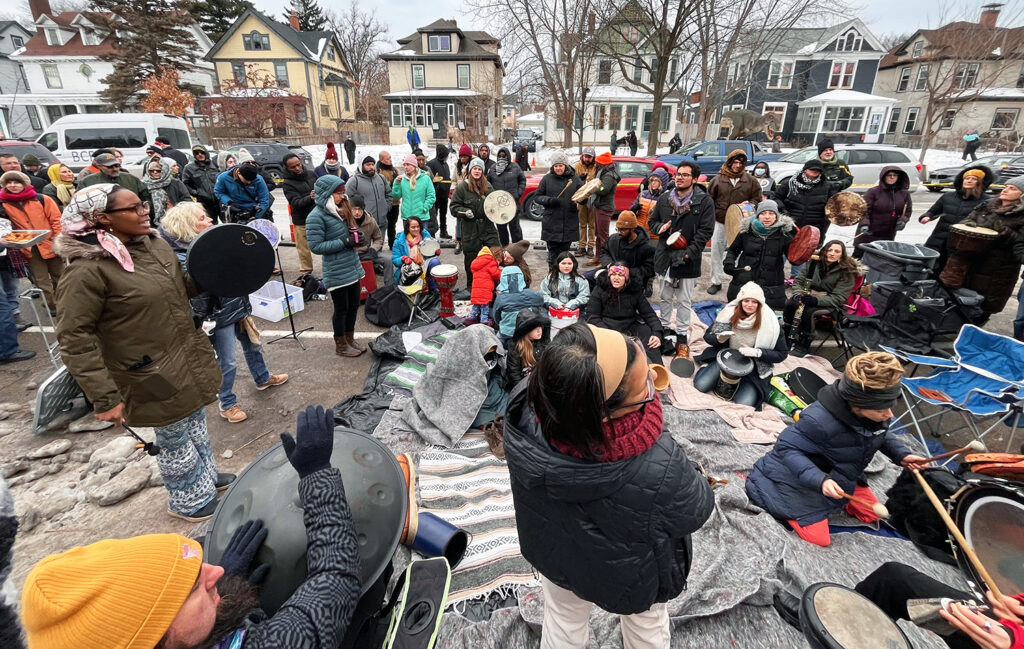
I couldn’t tell you exactly what I said, but I can tell you what I witnessed among the nearly 200 people gathered.
At first: tension. Apprehension. Hesitation to chant or release.
But as the drums deepened and the rhythm took hold, something shifted.
Fear softened on faces. Breaths slowed. Bodies relaxed. I saw people hugging. Voices chanting so intensely their bodies moved with the rhythm.
In that moment, I witnessed something felt by the group: regulation is not avoidance; it is capacity.
Community Is a Force Multiplier
We live in a digital world, increasingly independent, often disconnected from our villages.
>It’s tragic that we often come together only in times of distress, and yet, it’s beautiful. Healing scales. Presence compounds.
Minnesota came together on January 11th. Hundreds of people decided that day would be filled with music.
A newscaster even asked: “People are saying Minnesota is bringing music today — what do you have to say about that?”
All I could think was this: it was a collective feeling. A shared desire to express differently. To bring beauty into corruption. To show that love can still overcome.
That day, 600 people marched and sang. Two hundred gathered around drums. Music echoed on every corner.
The message was unmistakable:
We are one.
We belong to each other.
We love.
Love.
Minnesota chose it strategically. To choose love in a culture addicted to rage brings clarity to what people truly want.
The One Heart drum circle was not a protest against; it was a demonstration for.
It challenged anger, fear, and hate by offering something else.
In those moments, it was impossible not to feel surrounded by people who would look out for you, and whom you would look out for, regardless of belief, background, or race.
We breathe the same air as we walk these shared paths on Earth.
Imagine This Scene
The final drumbeat lands. A collective silence. A deep, shared breath. The air feels lighter. The crowd softer. Even joyful.
Officers offer hand warmers and make space. Warm drinks and food being passed around. People share stories of softened hearts, released anger, and grounded bodies.
For a moment, you see what the world can look like when we come together and regulate our nervous systems, when we expand our capacity and heal collectively.
What kind of world could we build if we kept meeting each other this way?
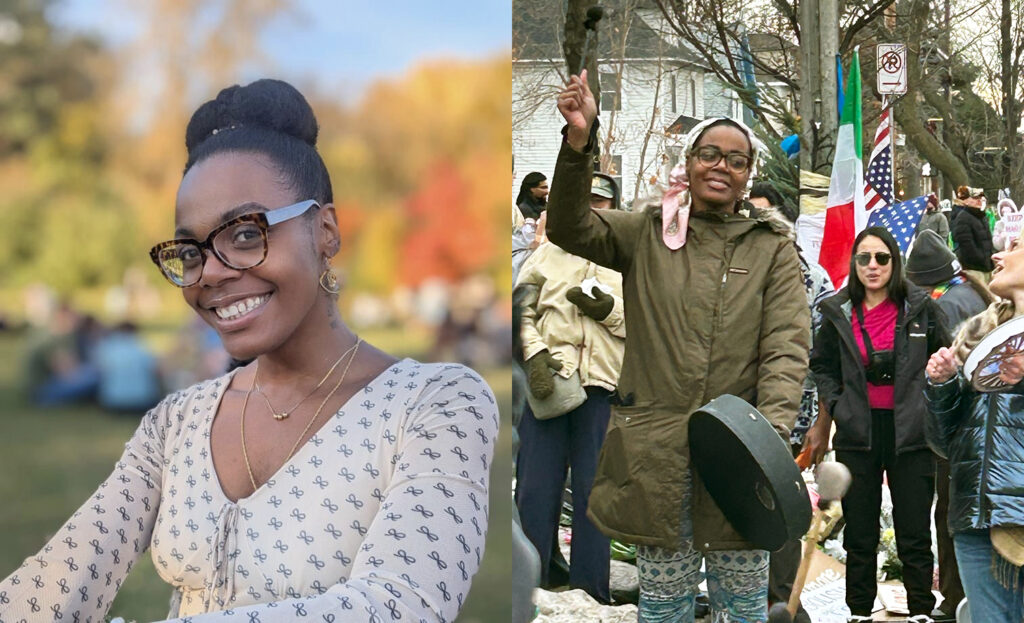
Diamond Barton is a community organizer, mother, and host devoted to creating spaces where collective coherence can emerge. Through movement, music, storytelling, and community-led ritual, she invites people to regulate together, process grief and joy, and remember their shared humanity.
As a musician, Diamond weaves sound and rhythm into her work, using music as a bridge between presence, expression, and nervous system regulation. Her gatherings honor embodiment as a form of worship and community as a living vessel for healing, presence, and love, especially in moments of unrest. Diamond’s work invites people out of isolation and into relationship, reminding us that transformation is most powerful when it is shared.