
By Alliance President Terry Gips
In a world that seemingly has gone mad, there is a steady, profound and inspiring voice for sustainability that has been around for more than nine decades. That rich, resonant baritone voice belongs to a short, slight global giant, Dr. David Suzuki, who I consider one of the world’s top Sustainability Superstars and Canada’s Dean of Sustainability, Science and Sanity.
He looks the part of the Karate Kid’s martial arts master Mr. Miyagi. Indeed, he’s as much the zen master of sustainability with his wizened wisdom coming forth: “How you imagine the world determines how you live in it.” He adds, “If we pollute the air, water and soil that keep us alive and well…no amount of money will save us.”
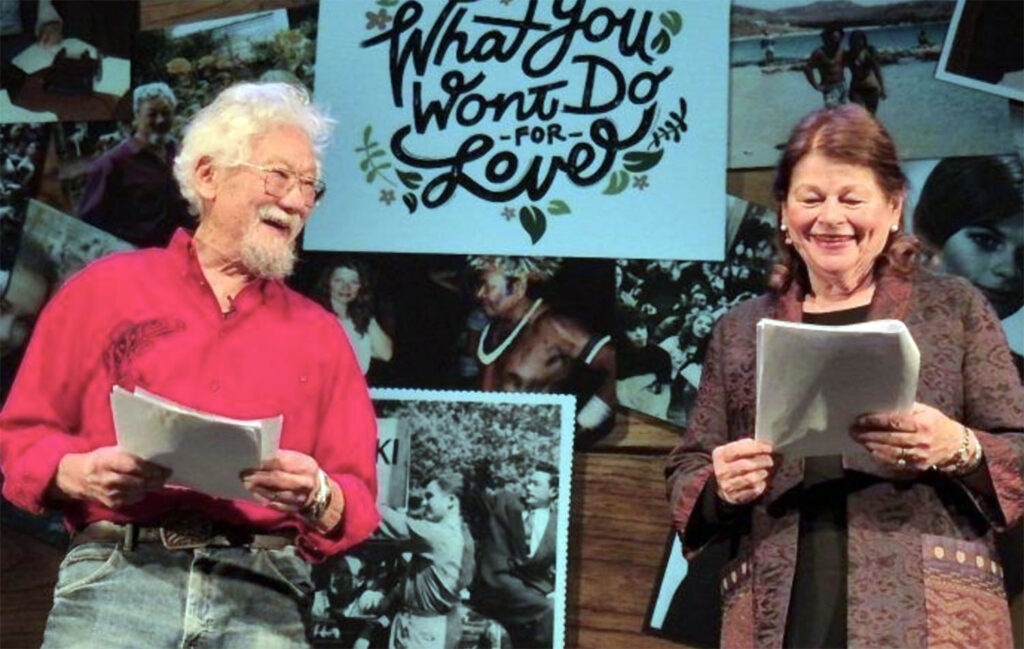
On November 15 at 2 pm you’ll have the opportunity to experience this incredibly sweet, brilliant and funny activist scientist and educator, along with his 53-year partner in “good trouble”, Dr. Tara Cullis, an award-winning writer and former Harvard faculty member who has been a key player in environmental movements in the Amazon, Southeast Asia, Japan and British Columbia.
They’ll be performing their riveting, hope-filled play, “What You Won’t Do for Love”, at The O’Shaunessy at St. Catherine University in St. Paul. It provides insights about their remarkable lives, hard fought battles and impact. It will be followed by time to interact with the audience. You can save 20% using code SUSTAINABILITY.
In this piece I want to share why I hope you’ll join me and the Alliance for this unforgettable, not-to-be-missed opportunity to experience stories based on his 90 years of transforming our planet.
From his humble, fraught beginnings, he rose to become a brilliant scientist and globally-known radio and television personality who also co-founded a powerful foundation. You’ll discover some of his greatest victories, key teachings and the historic talk his daughter gave that went around the world.
Nine Decades of Awakening the World
I’ve watched and experienced Suzuki’s genius for more than half a century. I’ve been with him as he has spoken to world leaders and fought racism and climate denialism. He educated an entire nation beginning In 1975, when he helped launch and host the long-running Canadian Broadcasting Corporation (CBC) Radio’s Quirks and Quarks.
In 1979, he became familiar to audiences around the world as the beloved host of CBC TV’s wildly popular The Nature of Things, the science show he worked with for 45 years.
He has also shifted scientific and popular thinking through the David Suzuki Foundation and his 55 books (nearly 20 of which are for children), explaining complex topics through his unique blend of humor and fierce urgency. He has been a consistent wake-up call for our planet and people.
In 2010, the National Film Board of Canada and Legacy Lecture Productions produced Force of Nature: The David Suzuki Movie, which won a People’s Choice documentary award at the 2010 Toronto International Film Festival.
He still continues to write a weekly column, Science Matters.
Suzuki has always been a luminous servant leader, exemplifying our highest values and beguiling us to live in harmony with each other and the planet. “We are part of nature,” he continually reminds us and our fate is inextricably tied to that of nature.
He not only humbly walks the talk, but his relatively tiny stature stands tall, always willing to speak truth to power while showing sustainability solutions and cajoling all of us to co-create a world that works for everyone and all life.
Founding the David Suzuki Foundation
He and Tara Cullis began the Foundation in 1990 with the “mission to protect nature’s diversity and the well-being of all life, now and for the future. Our vision is that we all act every day on the understanding that we are one with nature.”
It’s a national, bilingual non-profit organization headquartered in Vancouver, with offices in Toronto and Montreal. It’s current focuses on three paths to sustainability:
- Climate Solutions – By 2030, in Canada, we’ll cut carbon pollution in half. By 2050, in Canada, we’ll eliminate carbon pollution and use 100 per cent renewable energy.
- Thriving Nature – By 2030, in Canada, we’ll protect and restore the most at-risk ecosystems and species. By 2050, in Canada, we’ll conserve and restore nature so that it supports biodiversity.
- Sustainable Communities – By 2030, in Canada, we’ll thrive while reducing our ecological footprint by a third. By 2050, in Canada, we’ll live within Earth’s finite limits.
Through evidence-based research, education and policy analysis, they work to “conserve and protect the natural environment, and help create a sustainable Canada.” They regularly collaborate with non-profit and community organizations, all levels of government, businesses and individuals.
Humble Beginnings in a Dark Chapter of Canadian History
Suzuki’s life began in the darkness of a Japanese internment camp, when at the age of 6 he and his family, along with 22,000 fellow Canadian citizens of Japanese descent, were forced from their homes and essentially imprisoned for three years. The government seized and sold their homes, fishing boats and businesses at low prices to cover the costs of the camps.
Suzuki was bullied by other young kids there because he couldn’t speak Japanese. As he has said, “When the victims of racism become racist, then racism wins.”
His Rise to Become an Academic Superstar and Highly Honored Leader
Suzuki excelled as a student and earned a PhD in zoology from the University of Chicago in 1961. He had offers to undertake an illustrious career of research and teaching at places like MIT.
However, he chose another path after witnessing outright racism directed at a Black colleague when he was a fellow at the Oak Ridge National Laboratories in Tennessee. His own self-reflection led him to see his own racism so he chose to return to Canada in a move that his colleagues said was “crazy” and “science suicide.”
He returned to Vancouver and was a professor in the genetics department at the University of British Columbia from 1963 until his retirement in 2001.
Suzuki has received numerous awards, including:
- Companion of the Order of Canada: Canada’s highest civilian honor (2006)
- UNESCO’s Kalinga Prize for the Popularization of Science (1986)
- The UN Environment Programme Medal (1985)
- The Right Livelihood Award, better known as the “Alternative Nobel Prize”
- 30+ Honorary Doctorate Degrees from universities across Canada, the US and Australia
Decades of Impactful Advocacy
Suzuki has long been at the center of Canada’s most prominent environmental policy disputes, as well as numerous global ones. Some of his major policy campaigns, legal battles and systemic targets include (thanks to Google AI):
- The Right to a Healthy Environment (The Blue Dot Movement launched in 2014) with the goal of enshrining the fundamental right to clean air, fresh water and healthy soil into the Canadian Constitution. The multi-year grassroots campaign successfully influenced the passage of Bill S-5, which modernized the Canadian Environmental Protection Act (CEPA), recognizing for the first time that every person in Canada has a right to a healthy environment.
- Strategic Litigation and Climate Accountability – Suzuki and his foundation have repeatedly used the Canadian court system to challenge federal and provincial policies:
- La Rose v. Her Majesty the Queen: From 2019 to 2024, the Foundation served as the primary partner backing a climate lawsuit brought by 15 Canadian youth. The lawsuit alleged that the federal government’s continued support of fossil fuel infrastructure violated their Charter rights to life, liberty, and security.
- David Suzuki Foundation v. Minister of Fisheries and Oceans: Suzuki successfully fought a landmark legal battle under the Species at Risk Act (SARA). The federal court ruled that the government could not rely on non-binding, vague policy guidelines to protect the critical habitat of Resident Killer Whales, forcing stricter legal conservation compliance.
- International Climate Treaties and Carbon Pricing – Suzuki was an early and aggressive champion of the Kyoto Protocol, pressuring the Canadian government to ratify the accord to establish binding greenhouse gas reduction targets. He has consistently lobbied for aggressive carbon taxation, establishing a “Carbon Manifesto” that demanded a rapid transition away from fossil fuels, an end to government subsidies for the oil and gas sector, and strict federal net-zero emission laws.
- Indigenous Sovereignty and Land Conservation – Suzuki has aligned much of his policy platform with First Nations, arguing that Indigenous stewardship is vital to ecological preservation. These actions include:
- The Great Bear Rainforest: Suzuki’s foundation carved out a path for government-to-government negotiations that led to the Great Bear Rainforest Agreement, protecting vast tracts of British Columbia’s coastal temperate rainforest from industrial logging.
- Resource Extraction Blockades: He has actively supported Indigenous-led policy resistance against major infrastructure projects, including the Site C Dam on the Peace River, Northern Gateway oil tankers, and open-net salmon farming off the Pacific coast.
- Transition to Post-Mitigation Localism – Suzuki’s policy perspective underwent a sharp shift. Citing political inertia, the influence of the fossil fuel industry, and global breaches of planetary boundaries, Suzuki openly stated that standard political mitigation strategies had effectively failed to stop climate change. His active policy advocacy has transitioned from lobbying federal governments toward building hyper-local community resilience, disaster preparedness, and independent local infrastructure.
- The Illusion of Separation: Humans Are Part of Nature, Not Separate From It – He teaches that clean air, water, soil, and biodiversity are non-negotiable biological requirements for survival, not resources to be endlessly exploited.
My sense is we’ve been brainwashed into believing we are not only separate from nature but superior to all other species rather than being in kinship. - The Four Elements – Suzuki emphasizes that we are made of the earth, air, water and sunlight. Clean air becomes our breath, clean water becomes our blood, and the soil grows the food that builds our cells.
What I love about this is that it personalizes the four elements, making them directly relevant to each of us. - Natural Laws Outrank Human Economics – He argues that human constructs — such as borders, corporations, financial markets and the demand for infinite economic growth — are artificial. They must bend to the immutable laws of physics, chemistry and biological carrying capacity rather than the other way around.
I was trained as an agricultural and applied economist yet share Suzuki’s critique of traditional economics (which has earned its reputation as “the dismal science”) because it has treated nature as an “externality.”
In Suzuki’s view, “In a world where everything is connected, a healthy environment must always come before a healthy economy because money holds no value on a dead planet.” He bares the fundamental truth that human economies are completely dependent on the living systems of Earth. - Value of Traditional and Indigenous Knowledge – Suzuki emphasizes that science and traditional Indigenous wisdom must work together. First Nations perspectives offer vital lessons on living in balance with the land and respecting a “sacred balance” of life.
Consequently, Suzuki has been a long-time champion of the rights of First Nations people. - Cultural and Genetic Diversity – Just as genetic diversity protects biological species from extinction, Suzuki recognizes that cultural and linguistic diversity builds resilience in human societies. He warns against corporate “political monocultures” that homogenize human values and prioritize short-term profit.
He has continually countered the corporatization of the world. - Action as the Antidote to Despair – Suzuki maintains that environmental anxiety and climate grief must be countered by local engagement, community-led movements, political voting, and storytelling. Doing something active restores hope and agency. [1, 2]
He is a constant voice for hope through action, as reflected in his articles like, Why we can’t lose hope: Dr. David Suzuki speaks out. As he says, “I can certainly see that people in the environmental movement are being disheartened…[but] we’ve all got to do our little bit…Actually doing something invigorates you.” - The Role of Elders – In his later work through initiatives highlighted by the David Suzuki Foundation, he calls on older generations to use their freedom from career-building pressures to speak the unvarnished truth and protect the future for grandchildren.
As someone who is increasingly an elder, I so admire Suzuki’s energy at 90 and his call for us who have greater freedom in terms of responsibilities to use our talents to make a difference.
Key Teachings
Suzuki wide-ranging mind has touched on so many aspects of sustainability in his 55 books that it’s hard to encapsulate them all. Here are just a few of the key ones:
One of David and Tara’s Greatest Gifts to the World
I hope this gives you a sense of the extraordinary man David Suzuki is and the gift he is in our world. I’ll conclude with one of his and Tara’s most wonderful gifts to all of us: their daughter Severn Cullis-Suzuki.
At the age of 12, Severn attended the 1992 UN Earth Summit in Rio. She gave what became an historic 6-minute speech to all the delegates on behalf of the Environmental Children’s Organization (ECO), a group of Canadian children she co-founded with her friends.
All of us were transfixed and inspired, and she received an unstoppable standing ovation. It was certainly one of the most memorable, impactful speeches I’ve ever heard. And her message resonates as much today as 34 years ago.
She challenged world leaders and adults to take responsibility for environmental destruction, famously stating: “If you don’t know how to fix it, please, stop breaking it.”
She voiced fears about ozone depletion, polluted air, cancer-ridden fish in her hometown of Vancouver and mass species extinction. She also criticized the greed of wealthy nations and urged leaders to redirect money spent on war toward solving poverty and environmental crises. Oh, if we had only responded and acted.
But her most famous line was, “You grown-ups say you love us, but I challenge you: please, make your actions reflect your words.”
That’s some legacy, Tara and David.