By Alliance President Terry Gips
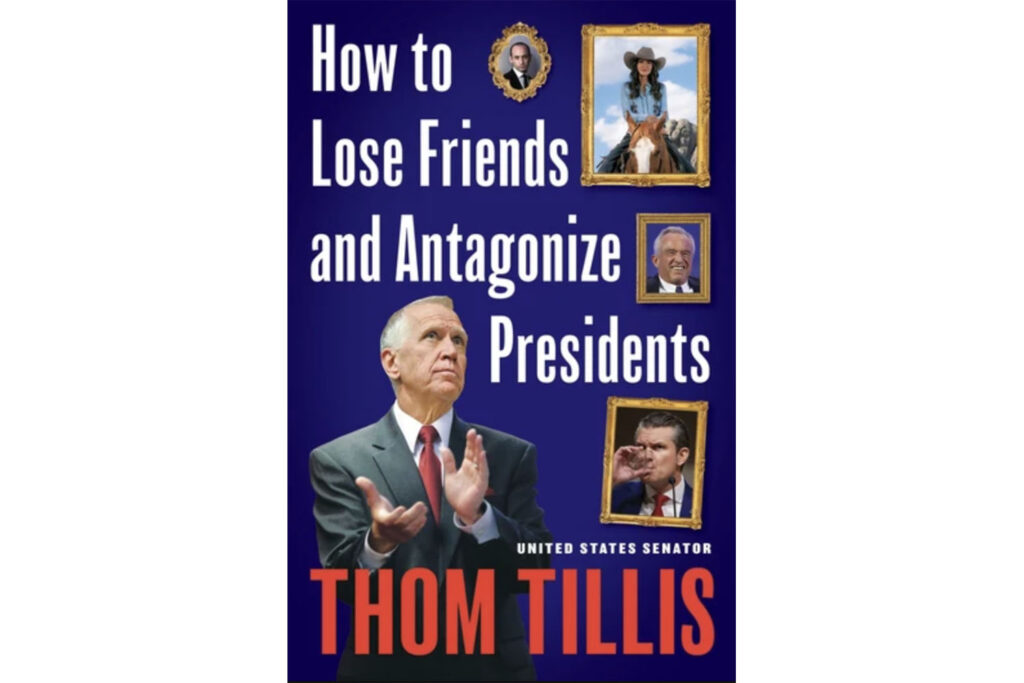
The provocative title of the new book by retiring US Sen. Thom Tillis (R, NC) lays out his fraught career and beef with his party:
How to Lose Friends and Antagonize Presidents: The Trouble with Sycophants, Courage Outsourcing, and Partisan Groupthink
The book’s description further amplifies this: “Tillis drags readers inside a Senate that too often behaves like a group of teenagers in a bad parody of a horror movie — heading straight toward the chainsaws instead of a nearby getaway car. Tillis takes us into a world of grifting sycophants and useful idiots in Trump 2.0”.
As the NY Times points out, “he effectively confesses to his complicity in the predicament his party now faces, placing himself in a long line of Republican members of Congress who only break with Mr. Trump once they no longer have a political future or power to thwart his agenda.”
The book exposes the underbelly of DC’s real politik and documents the proverbial how sausage is made with colorful, tell-it-like-it-is assessments:
“While there are many good people currently employed in the West Wing, too many others are cynical, shameless, boot-licking sycophants who shouldn’t be allowed to tour the White House, let alone work there.“
Yes, having worked as a White House aide for President Carter and for two US Representatives, I must confess a certain satisfaction with his analysis. And I was equally delighted by his boldly naming names and attaching harsh labels to some of Trump’s most offensive sycophants, who he labels “MAGATS”.
Highlights include “psychopathic, dog-murdering” former Homeland Security head Kristi Noem and Senior White House Aide Stephen Miller, the “Architect of Most of the Dumbest Proposals”, including the plot for the US to take Greenland. Tillis calls this proposal “amateurish” and “insane.”
Ok, I must also confess that in the upside down, dark world Trump has created, a conservative Republican’s assessment helped me justify my own harsh judgements about the out-of-control people and policies that have harmed our country. And yet, while it feels satisfying, it is also scary.
At this point, you may be wondering how does this article help us overcome uncivil wars. The truth is it doesn’t in the same way that other pieces in this series do in a positive, straightforward manner.
Instead, it focuses on the complex processes of challenging those in power to do the right thing. The result may not satisfy, but lays out the difficult, often conflicting and confounding, aspects of who we are as humans. If we don’t seek to understand and confront this, we’ll likely never achieve our larger goals of coming together. When I proposed this review, the immediate response I got from our staff was revulsion at the idea Tillis has anything of value to share given his key role in enabling some of the worst policies and appointments of the Trump regime. I argued it’s an important Republican critique of a President and party that remains unbounded by essential guardrails for our democracy and future. Then I got pushback that Tillis was a Johnny-Come-Lately in his response, which I acknowledged. I still argued that at least he was speaking up and not silent like most other Republicans protecting their own self-interest and political careers. As I’ve thought about it more, I came up with five reasons why I feel it’s important to explore: I thought I could easily take on his book because I’ve watched this colorful character for years and felt it would be a simple, fun task with my just sharing some of the book’s greatest hits. Little did I realize the complexity of the task and the nuance needed. It’s not a black-and-white case. The hot headlines are certainly there but so are needed critiques of his critiques. Despite this, I hope you’ll gain important insights into us humans that are essential for us to achieve our badly-needed shift to sustainability, even if the path is not as bright and hopeful as I might have thought. One thing is certain: If we don’t see the self-destructive insanity of our present situation, we’ll all be going down with the ship. How to Lose Friends does beg many questions, like where are the rest of the Republicans and why aren’t they speaking up? Tillis documents the literal assault that takes place on legislators who don’t fall in line, leading to pathetic profiles in cowardice. That’s just one of the five eye-opening takeaways from the book I’ll share, with perhaps the most relevant one being the threat to the survival of our democracy and planet. I’ll also share some of the brutal critiques of the book, with perhaps the biggest being why Tillis didn’t speak out sooner. I’ll show that he did but he still was the deciding vote in favor of appointing people like Pete Hegseth and Kristi Noem, decisions he now regrets. And I’ll end with why all of this matters for sustainability and survival. But first, I feel it’s important to have some context about the good, bad and ugly of Tillis and his career. Thomas Roland Tillis is an American businessman and Republican politician who has been the senior US Senator from North Carolina since 2015. From 2007 to 2015, he served in the NC House of Representatives, of which he was speaker from 2011 to 2015. He labels himself as a conservative but in a shifting political landscape, some Republicans now call him a moderate Republican. “As Sen. Tillis has gained influence in Congress for his willingness to work across the aisle, his record on LGBTQ+ rights, immigration and gun violence has raised concerns among some state Republicans that the senator has strayed from conservative values,” according to PBS. He is no angel, but Tillis has bucked his party in taking positive, sometimes nearly heroic positions. At the same time, he has supported deeply disturbing, devastating ones as you can see in the accompanying piece I put together. He has shifted positions over time, in many cases becoming more liberal. For this, Tillis has faced harsh attacks from his own Republicans party in NC, according to PBS. At the 2023 annual Republican convention in NC, delegates voted to censure him for supporting policies they said violate key tenets of the GOP platform. What did he do wrong in their eyes? He supported the Respect For Marriage Act, which enshrined protections for same-sex and interracial marriages in federal law, which both the state and national GOP platforms opposed. My take on the book’s top highlights: Reviewers and columnists (such as in The Charlotte Observer) have leveled a range of critiques against Tillis regarding him and his book: Those are reasonable critiques, but I also think it’s important to know Tillis has confronted Trump during both his first and second terms. As he points out, “Just to set the record straight, I stood up to President Trump on many occasions in his first term“: In the second term he has challenged the Trump administration in many areas, pointing out: “There’s nothing conservative about setting up a $1.776 billion fund for scumbags who beat on cops and stormed the Capitol. There’s nothing conservative about spending millions on TV commercials while your ICE thugs gun people down in the streets, or starting investigations of your Fed chair because he won’t fall in line like all the other spineless lowlifes who work for you.” Let’s start with this. Tillis says, “I am writing this book to save my party from itself, and to save the president from the temptations and tragedies being set upon him from MAGA extremists like Loomer and Bannon who have no understanding of governance, politics, or simple human decency.” That’s a noble thought. Throughout the book, he has a ready critique of MAGA, White House Staff and Trump’s cabinet appointees, but it’s shocking he still somehow bears no ill-will towards Trump despite the President’s vicious personal attacks on him. Despite all his indicting, profanity-laden critiques, Tillis still says about the book, “It’s not meant to tear down a Republican Party that I still believe in, or even President Trump himself, whom I still support.” Wow! What would it take for Tillis to see the sociopathic narcissistic President he is and not support him? Why can’t he call out Trump after writing a devastating critique of Trump’s henchman? Trump bears no responsibility for his appointments and endorsement of their policies? And how is it that Tillis still believes in the Republican party that has enabled Trump’s power and domination? It’s bewildering to me that Tillis somehow supports and speaks favorably about Trump and his agenda to become a self-styled king pushing an authoritarian agenda a la Putin and Xi. That’s tough for a pragmatic, idealistic humanitarian like me. I just don’t get his logic, and it bodes ill in our attempts to find common ground for co-creating a world of sustainability, health, equity and kindness. I do hope we can celebrate every person who recognizes the error of their ways and seeks to come clean and speak out, such as former Republican Congressman Adam Kinzinger. Every time conservative leaders like Tillis and Kinzinger speak out, it creates more space and permission for others to do the same. It’s also an acknowledgement that there are still things called facts, not “fake news.” The “fake news” narrative perpetrated by Trump since his overstatement about the turnout at his Inauguration, has done such damage, dividing us into a PT (Post Trump) world of objective, verifiable facts and Trump’s MAGA world in which Big Brother tells us his truth, regardless of verity, and followers drink the Kool-Aid. Such a world does not allow people to come together to find common sense sustainability solutions. Each side becomes an enemy camp, filled with “othering”, judgement and attacks. It sets the stage for uncivil war and, ultimately, planetary destruction. We have to escape this zero sum worldview and come to our senses and sustainability. Pushback Against This Political Book and Why is it Important to Explore?
An Overview of the Many Disturbing Takeaways and Questions the Book Raises
A Complex Conservative with Nuance
Five Big Takeaways from the Book
Critiques of the Book
A Semi-Defense: Tillis Has Challenged Trump in Both Terms
The Challenges this Book Poses for Sustainability and Survival