
By Alliance Communications Coordinator Amy Durr
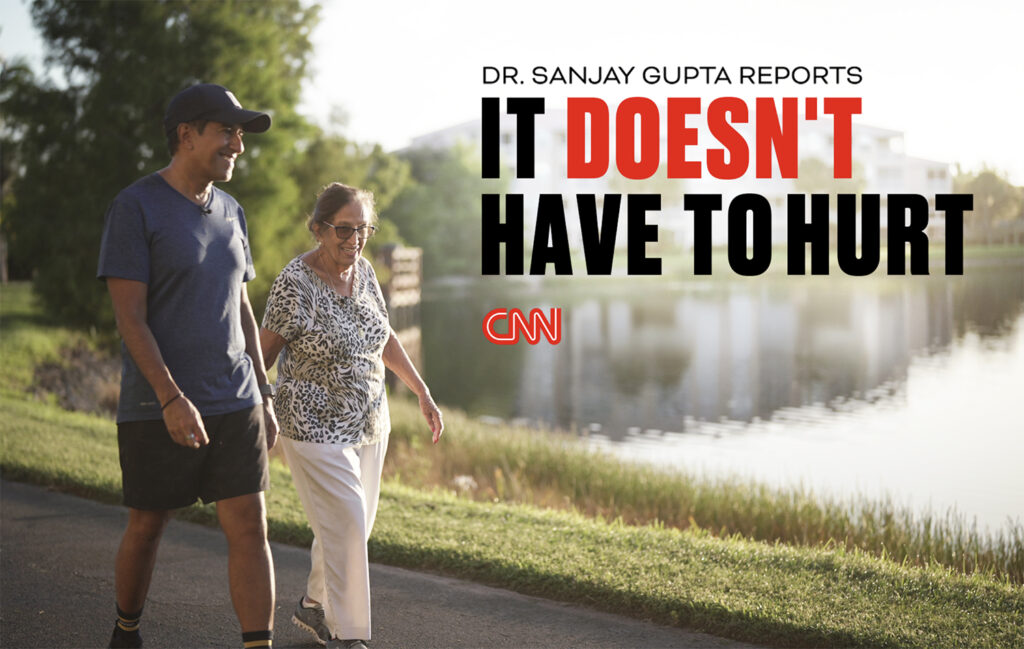
If you’re living with chronic pain, Dr. Sanjay Gupta’s new book starts with something unexpected: hope. Maybe this startled you as much as it did me. Most of the people I know who live with persistent pain lose hope over time. But Gupta’s personal story “offers a sense of optimism for the hundreds of millions of people suffering from chronic pain, and particularly those who have felt forgotten, suffering inside bodies they believe have betrayed them.”
If you haven’t been through the medical maze — RICE (rest, ice, compression, elevation) protocol, imaging, medications, physical therapy, pain clinics — you probably know someone who has. Nearly 60 million Americans — that’s 1 in 4 adults — live with chronic pain. Most days, every day, for months on end.
Gupta’s book, It Doesn’t Have to Hurt: Your Smart Guide to a Pain-Free Life, is detailed, comprehensive and hopeful, suggesting many practical ways to both prevent and relieve pain. Gupta covers the full spectrum, from back pain (the most common), arthritis and neuropathy to neck pain and migraines.
And here’s what I learned — most people dealing with chronic pain aren’t fighting one battle. They’re fighting six, ten, sometimes fifteen different conditions at once. One person in Gupta’s research had forty-two contributing conditions. Forty-two.
If that were all I could share, I’d recommend this book as a fabulous read. But many of Gupta’s insights apply whether you wake up in pain or not. His view is holistic, sadly still uncommon in Western medicine. I’m going to take you on a journey exploring the new understandings about pain and Gupta’s seven strategies for preventing and reducing pain, plus a new FDA-approved drug for eliminating pain, its first such medication in 20 years.
Brains Create Pain, and Can Rewire Themselves to Decrease the Hurt
“Here’s what we do know: Pain does not start where you might think, at the broken bone in your wrist or your twisted ankle,” writes Gupta. “It begins when your brain scrambles to make sense of the sudden new signals coming from these injured places. Your brain rapidly tethers new information to existing information such as previous similar exposures, corresponding expectations, social norms, and other sensory data. Looking down and seeing blood on your hands, for example, will in all likelihood objectively worsen your pain…
“The point is that the brain creates pain on cue from a vast array of stimuli — biological, psychological, social, emotional, environmental, even cultural. And just as we now understand that the brain can be nurtured, developed, and optimized at any age, there’s growing evidence that the brain can also rewire itself in ways that change the neural circuitry for pain, reducing its intensity or duration and potentially eliminating it altogether.”
Gupta returns to this theme again and again. In terms of pain management it’s critical, because it means that there is always hope for reducing pain. Our brains rely on old scripts and cultural expectations to decide how much pain we feel. It’s exciting to know that we can upend both and write new ways of being for ourselves. As Gupta’s book relates:
Harvey Rich, a physician, psychoanalyst, and founder and past president of the American Psychoanalytic Foundation, spent years as an embedded physician in traumatized, war-torn communities around the globe. He engaged in community-based work alongside local healers and witnessed traditional healing practices — rituals, ceremonies, drumming and healing circles — [that] produce spontaneous recoveries unexplainable by Western medical science.
The healing agent, Rich says, “was the presence of the community and the force of the group. I believe that such matters really do deal with pain and mental anguish. We do not have that in our Western culture anymore; we are relegated to pills and practices that are done in isolation.”
What We Once Called Alternative Therapies Need to Become Mainstream
To take just one example of problematic pain that sometimes feels intractable, let’s consider migraines. Even with migraine-specific medications, many patients still face high, disabling, or persistent pain, indicating that for many, current medication may not provide adequate relief. As with many chronic pain conditions, available medications often don’t help, or don’t help enough.
Gupta’s consideration of migraines is far more comprehensive:
Some mind and body practices, such as relaxation training, biofeedback, acupuncture, and spinal manipulation have been found to be helpful for headaches and migraines. Preliminary studies suggest that certain dietary supplements, including the herb feverfew, the vitamin riboflavin, the mineral magnesium, and coenzyme Q10, may also be helpful for migraines. The herb butterbur seems to reduce migraine frequency, but serious concerns have been raised about its possible liver toxicity.
Gupta’s 7 Reset Strategies for Pain-Smart Living Apply to Most of Life, Too
Dr. Gupta knows that pain is one of the few human experiences that can cut across every facet of our lives. “To help you prevent that from happening, I’ve created seven strategies. They’re based on the merged best practices recommended by leading pain and preventive health experts, supported by science, and offered up by pain sufferers I’ve interviewed,” Gupta tells us.
- Mind your brain: Mindfulness, psychotherapy, hypnosis, self-hypnosis
- Befriend your body: Mind-body practices, myofascial release and other manual therapies, acupuncture
- Move more: Exercise, movement, yoga, tai chi, dance
- Sleep well: Relaxation and restorative sleep, developing habits that improve sleep
- Eat well: The pain-smart pantry, anti-inflammatory eating plans, gluten-free or other dietary considerations as needed
- Cultivate connection: Personal, social, and community relationships that support and strengthen a sense of connection
- Savor moments and memories: The power of your focused attention on positive experience
More than anything else, for me these seven strategies speak to the amount of agency we have over pain, our health and, indeed, our entire lives. Gupta reminds us we should not be passive participants in our medical care or any part of our messy, beautiful lives.
Gupta points to Dr. Joel Saper, the Founder and Director of the Michigan Headache & Neurological Institute, who had a most revolutionary concept: “treating the patient not as a passive participant but as an active investigator working shoulder to shoulder with the experts. By focusing on not only the ‘what’ of treatment but also the ‘who’ — a patient’s history, outlook, and expectations — he created an optimal healing environment. He helped people believe they could drive their own care.”
These seven strategies work beyond pain. We can use them to improve sleep, stress management, general wellness, energy, and immune health — all of which play a role in pain. If we learn to pay attention to our brains, our bodies and our boundaries we can have much more influence over the things that plague many of us: pain, sleep, and loneliness.
A Breakthrough in Pain Medication
Despite more than a quarter of all Americans experiencing chronic pain, there have been no breakthroughs in pain medication for more than two decades…until now. The FDA gave approval January 30, 2025 to Journavx (suzetrigine), a first-in-class, non-opioid, non-addictive medication for treating moderate to severe acute pain in adults.
It marks the first new type of pain medication approved in more than 20 years. Journavx works peripherally by targeting sodium channels to stop pain signals, offering a non-addictive alternative for post-surgical and trauma pain. Journavx is expected to be a major alternative to addictive, highly regulated opioid painkillers.
Learn More and Share Your Experience
I’m sad that I didn’t have the space to encapsulate Gupta’s very detailed treatments for specific types of pain. I encourage you to read his book to get news ideas on how to manage your own pain. We would also welcome learning about any measures you’ve taken to prevent or alleviate pain.