
By Alliance Communications Coordinator Amy Durr
When I read or listen to poetry, I find myself swimming in the great rivers of primal emotions – sorrow, joy, anger, surprise, loneliness, love. I feel less alone. Someone else has felt those same emotions and expressed them for me in words.
Poems got me through my mother’s death. They got me through my child’s scary diagnoses, falling in love, getting divorced.
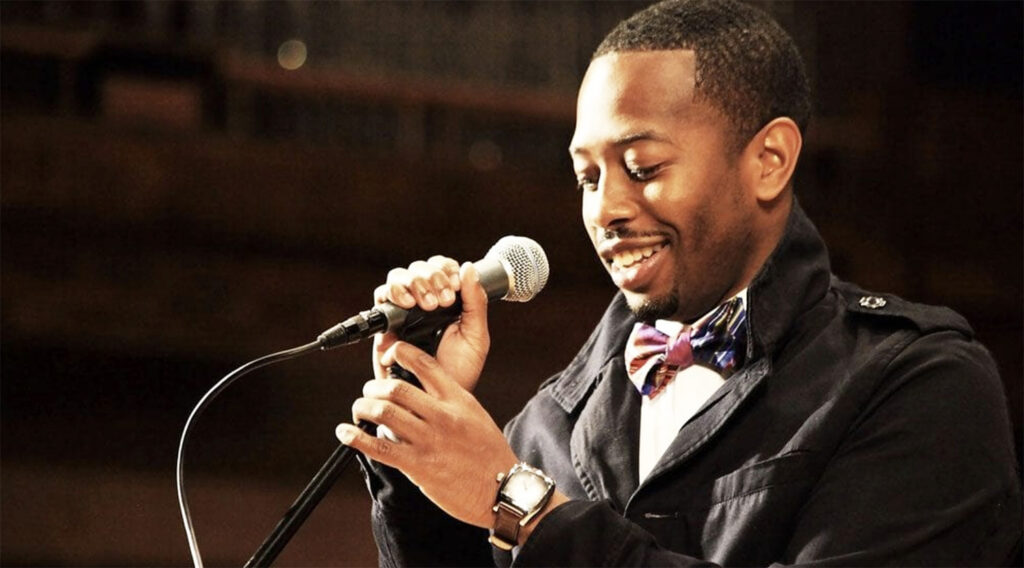
Looking for a poet to highlight for Black History Month, I was delighted to discover Rudy Francisco. Hearing his spoken word poetry brought strong emotions up to the surface, changed my perspective and perhaps even gave me some love.
To be frank, I’m a bit embarrassed I had never heard of Rudy Francisco, one of the most recognizable names in spoken word poetry. I’d like you to discover his powerful words in his poem Complainers for yourself, and then I’ll share some thoughts from me and others about his work.
Watch Rudy Francisco perform his poem Complainers:
Spoken Word Poetry Hits Differently
Did the pace and intensity of Francisco’s words enhance the poem for you? Could you relate to his stories, though they are not your stories?
I felt a little taken apart. I felt seen. I felt called out for having the ego to complain about things that don’t really matter. I felt sad for having given up my joy for things so small. I felt a maelstrom of conflicting emotions.
I’m quite often disappointed when listening to poets read their poetry. Poets are not always performers, of course, and I don’t expect them to be. But poems are rhythmic, and the rhythm, the line breaks, the confounding indentations, the little pauses, the odd punctuation – they all breathe life and meaning into the written words.
Francisco’s performance shows this beautifully. He exemplifies what makes spoken word poetry so electric. He and other poet performers add emotion and speed to their cadence to truly communicate the intricacies of their poems.
When Francisco says, “And each pulsin’, and each throbbin’, and each palpitation is a trophy engraved with the words, ‘You are still alive,’” near the end of his performance of Complainers, I feel my own heart beating along with his in my chest, but I also feel the heaviness, the urgency, the joy, the pain.
At the same time, I know that as a Black man, Francisco’s life experiences in the US are very different than mine. I was both needfully confronted and uplifted as a white woman listening to his poignant pleading and wondered how much more resonance those same words would have for a Black person, living through microaggressions every single day while being told to be thankful.
Francisco’s Roots and Impact
Rudy Francisco was born, raised and still resides in San Diego, CA. At the age of 21, he completed his BA in Psychology and decided to continue his education by pursuing an MA in organizational studies.
As his website points out, he “is an amalgamation of social critique, introspection, honesty and humor. He uses personal narratives to discuss the politics of race, class, gender and religion while simultaneously pinpointing and reinforcing the interconnected nature of human existence.”
I love the fact that Francisco seeks to create work that promotes healthy dialogue, discourse and social change. It’s great that he’s made conscious efforts to cultivate young poets and expose the youth to the genre of Spoken Word Poetry via coaching, workshops and performances at preparatory schools and community centers.
He well deserves the numerous awards he’s won, along with the admiration from countless colleges and universities across the nation, where he’s conducted guest lectures and performances.
The Power of Spoken Word Poetry to Foster Deep Empathy and Connection
One of the shining gifts of spoken word poets is the vulnerability of the performance, the opportunity to allow yourself to feel exactly what the performers are feeling, and perhaps even have a healing experience yourself.
“Gone are the days when poetry was trapped in textbooks, cloaked in obscurity, reserved for the elite. Today, poetry is on the pulse. It’s viral on TikTok. It’s blazing stages. It’s closing keynotes and opening hearts. And it’s spoken—boldly, powerfully, unapologetically—by artists who sound more like prophets than performers,” says spoken word poet Sekou Andrews.
“The best Spoken Word Poetry doesn’t just entertain—it educates, empowers, elevates,” Andrews continues. “It speaks into the void of division and fills it with connection. It takes the complex data of our lives and translates it into truth that’s simple enough to feel and strong enough to act on.”
In these nightmarish days, poems can activate and empower us, help us close the gaps between us and underscore our shared humanity.
Complainers
A spoken word poem by Rudy Francisco
Whenever I find myself complaining about the small things, I say to myself:
The following are all true stories.
May 26th 2003 Aron Ralston was hiking, a boulder fell on his right hand. He waited four days, then he amputated his own arm with a pocket knife.
On New Year’s Eve, a woman was bungee jumping in Zimbabwe. The cord broke, she then fell into a river and had to swim back to land in crocodile-infested waters with a broken collarbone.
Claire Champlin was smashed in the face by a five pound watermelon being propelled by a slingshot.
Matthew Brobst was hit by a javelin.
David Striegl was punched in the mouth by a kangaroo.
The most amazing part of these stories is when asked about the experience, I heard they all said, “I guess things could have been worse.”
So go ahead.
Tell me that you’re having a bad day.
Tell me about the traffic. Tell me about your boss. Tell me about the job you’ve been trying to quit for the past four years. Tell me the morning is a townhouse burning to the ground. Tell me the snooze button is a fire extinguisher. Tell me the alarm clock stole the keys to your smile, drove it into 7:00 AM, and the crash totaled your happiness.
Tell me. Tell me!
Tell me, how blessed are we to have tragedies so small it can fit on the tips of our tongues?
When Evan lost his legs he was speechless. When my cousin was assaulted, she didn’t speak for forty-eight hours. When my uncle was murdered, we had to find a search party to find my father’s voice.
Most people have no idea that tragedy and silence often have the exact same address.
So when your day is a museum of disappointments hanging from events that were outside of your control, when you find yourself flailing in an ocean of “Why is this happening to me?”, when it feels like your guardian angel put in his two week notice two months ago and just decided not to tell you, when it feels like God is a babysitter that’s always on the phone, when you get punched in the esophagus by a fistful of life, remember that every year two million people die of dehydration so it doesn’t matter if the glass is half full or half empty, there’s water in the cup.
Sometimes you just gotta drink it, and stop complaining.
You see –, you see, muscle, muscle is created by repeatedly lifting things that have been designed to weigh us down. So when your shoulders feel heavy, you gotta stand up straight, you gotta lift your chin, you gotta call it exercise. Remember that life is a gym membership with a really complicated cancellation policy.
Remember that you will survive. Remember that things could be worse. Remember that we are never given anything that we can’t handle.
When the world crumbles around you, sometimes you gotta look at the wreckage and then build a new one out of all the pieces that are still here.
Remember that you are still here.
The human heart, it beats approximately four thousand times per hour.
And each pulsin’, and each throbbin’, and each palpitation is a trophy engraved with the words, “You are still alive.”
You are still alive.
We are still alive.
Let’s act like it.