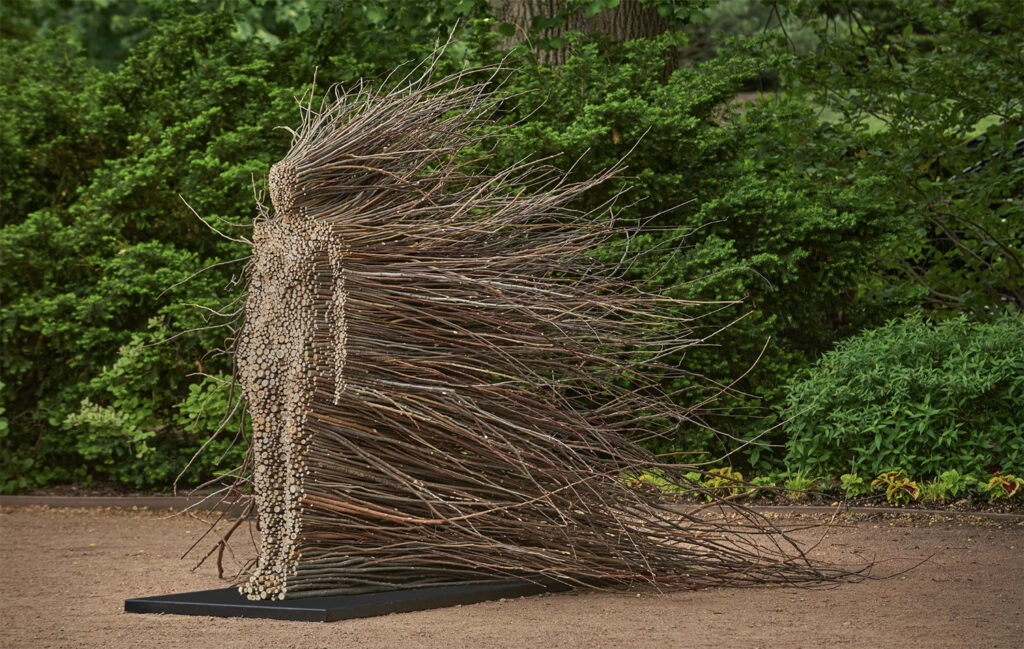
“Stillness in Motion: The Matka Series is a body of work that explores the concept of place. In this ongoing series artist Olga Ziemska uses locally harvested trees that grow native to an area to create a female figure in various places all around the world. The word “Matka” in Polish means mother, a person that is significant to the idea of place, origin and our first physical and universal environment — the womb,” says Room + Wild. Credit: Room + Wild
By Alliance Communications Coordinator Amy Durr
The title of artist Olga Ziemska’s piece Stillness in Motion seems contradictory until you see it and feel the still agitation of her female figure constructed of local prunings and fallen branches. From the front, an unmoving figure of a woman. From the back, a turmoil of growing, reaching organic forms.
In an interview with Room + Wild, Ziemska is described as a land art creator who
“mines nature, philosophy, and science in search of connection points among the physical forces, biological structures, and mystical underpinnings of existence. She often attempts to make visible those concepts or properties that are indiscernible to the naked eye, such as cellular formations or magnetism. By making visual associations between the visible and the invisible — or the microscopic and the macrocosmic — Olga poetically underscores the interrelatedness of all things.”
I’m always fascinated by artist interpretations which fall under the broad category of “land art.” Also known as earth art, land art is built by sculpting the land itself or by creating structures with natural materials within the landscape.
One with Nature
Ziemska had me at “poetically underscores the interrelatedness of all things.” Interrelatedness is a key to understanding the climate emergency and taking action. As human beings we need to comprehend how much we are intertwined with nature and are part of the natural world. We are not separate from it. This will be key to the survival of our species.
When describing how the location affects her artwork, Ziemska says:
“What is typically considered the background of an artwork — the surrounding landscape or environment — is pulled forward and integrated within the work and also highlighted by the artwork. This allows for the artwork to fall back and mesh with the surrounding environment.
“I enjoy this type of visual movement and interchange between what is considered the positive and negative space of my work. What is important can be shifted visually. What is considered foreground and background, art and landscape, can be interchanged, intermixed and melded together.”
Art as Continual Transformation and Return
Ziemska continues:
“With most of my work, there is an ephemeral quality to it, in that through the use of natural materials, the sculptures are always in a subtle state of flux and change. There is a natural life-span to the outdoor environmental artworks, therefore they are affected by the surrounding environment, weather, and time.
“The sculptures are in a slow and constant state of transformation and change, and the majority of my environmental artworks are intended to return back to nature in one form or another.”
A Portrait of the Artist
“Olga Ziemska is a globally recognized sculptor and environmental artist whose large-scale public artworks and site-specific installations explore the profound relationship between humanity and the natural world. A graduate of Columbus College of Art & Design (BFA, 2000), she gained early recognition through a Fulbright Fellowship at the Academy of Fine Arts in Warsaw, Poland,” according to her website.
“During this pivotal time, she created Stillness in Motion (2002) at the Center of Polish Sculpture — an influential work later featured in Sculpture Magazine (2003). This project marked her entry into the global environmental art discourse, establishing her as a leading voice in contemporary environmental art and outdoor site-responsive sculpture.”