By Alliance Intern Eleanor Hulan
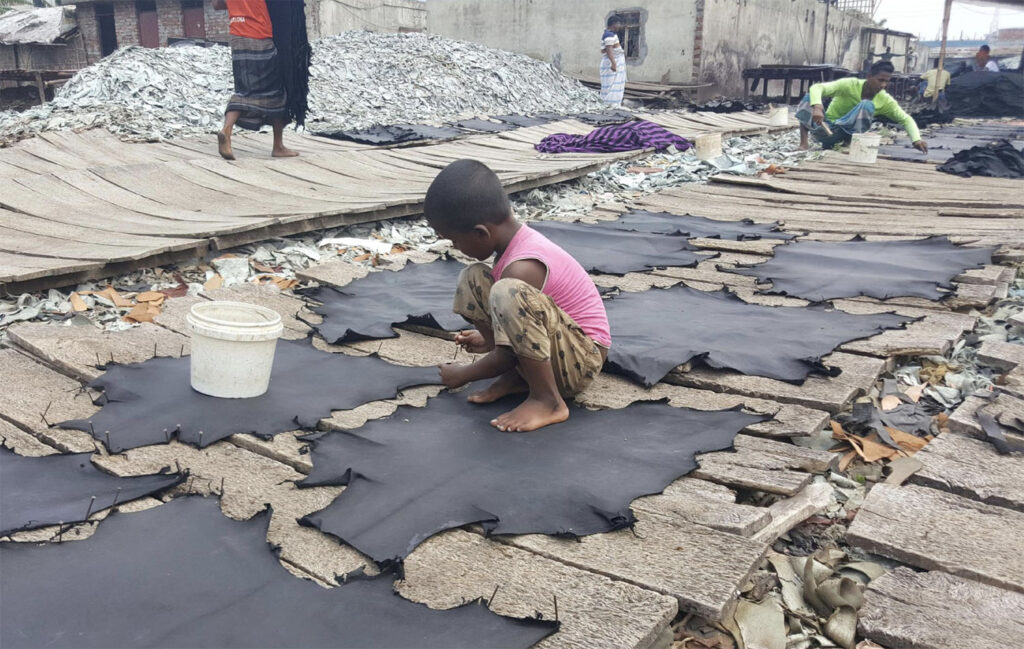
No person should have to work in the conditions chronicled in Green America’s 2026 report Hidden Hands: Child Labor in Bangladesh’s Leather Industry. And no child should have to work at all. However, 138 million worldwide still do, and the consumer economy continues to subsidize industries that engage in the very worst labor practices, directly and indirectly.
Green America’s report on the leather market in Bangladesh, with testimonies from a few of the 3.45 million children who are enslaved to this industry, is a horrifying reminder of the changes that must be made if we ever want to share in an equitable future.
It seems that there is often an utter detachment toward the shoes or belt we put on in the morning. The nonchalance surrounding who makes it, and the disregard of the human condition is chilling, but it is nothing new.
Sadly, Upton Sinclair’s The Jungle Still Exists in a New, More Deceptive Form
In 1905, Upton Sinclair’s The Jungle appeared in print, a testimony to the horrors of the American meat-packing industry. In the eventual novel, Sinclair used a fictional family to bring attention to an industry rife with child-labor, human rights violations, and pollution.
Half the year it would be dark as night when he went in to work, and dark as night again when he came out, and so he would never know what the sun looked like on weekdays. And for this, at the end of the week, he would carry home three dollars to his family, being his pay at the rate of five cents per hour—just about his proper share of the total earnings of the million and three-quarters of children who are now engaged in earning their livings in the United States.
This million and three quarters Sinclair mentions accounts for child workers between 10 and 15 in 1900. At least an additional quarter million were under the age of 10.
After the publication of the novel, American companies shaped up…sort of. Stricter child labor laws were put into place, and more mandates around food and worker safety were implemented. There are still many (many, many…) aspects of the labor market in the US that need gargantuan reforms, but some of its worst practices have been subsidized and offloaded to the Global South.
British rule in South Asia had the same effects: growing the previously family and community driven art of leather-work into a monstrous conglomerate of factories with despicable working conditions that target people from disenfranchised castes and religions.
How is the corner of an industry that we have known for centuries shortens lives and pollutes rivers, leaches chemicals and heavy metals into groundwater and habitually disregards animal and human welfare not only endured but flourished — with the consumer market almost doubling by 2030, and reaching over 600 billion by some estimates?
It’s because we allow it to. In 2024, the US imported $8.7 billion worth of leather goods from Bangladesh alone.
Violation of UN Child Labor Goals Exposed by Green America’s Report
One of the 2015 UN Sustainable Development Goals was ending worldwide child labor by 2025. Unsurprisingly, we have fallen short. In Bangladesh, India and Pakistan, children are a key part of the leather industry, working in tanneries and manufacturing.
As with many industries, leather relies on the covering up of the labor chain and externalities of the business. Companies headquartered in the Global North are able to obscure the violence and suffering inherent in the trade.
If you’ve ever read The Jungle, the personal stories in the Hidden Hands report may seem abhorrently familiar. Green America interviewed children in Bangladesh who reported effects of the industry ranging from chemical burns and broken bones to chronic respiratory conditions, physical abuse and trauma and PTSD. They work up to 16 hour days, and their life expectancy is 40 to 50 years.
The Economics of the Leather Industry Contributes to Widespread Challenges
There are a mix of financial incentives that subsidize the leather and meat industries, ranging from subsidies for corn and soybeans to USDA rewards for its price structuring of leather within the meat-packing system as a whole.
I would even suggest that these market-altering credits are essential to the profitability of animal agriculture. If they were taken away, it would have a real impact on the beef industry.
This would be a positive development because Green America points out that reducing beef consumption is critical in the fight against climate change, deforestation and biodiversity loss.
Profit margins in the leather industry are tight, resulting in horrible wages and working conditions. Bangladeshi leather workers are paid around $115 a month, less than 25% of a living wage in the area.
It also results in serious environmental and health damage. Several Bangladeshi proposals towards harm reduction have failed. One treatment plant, for example, “remains non-functional, and untreated toxic sludge continues to seep into the Dhaleshwari River.”
Your Leather Goods Contribute to Animal Suffering and Waste
The Green America Hidden Hands report also addresses the misconception of viewing leather goods as a by-product of the beef industry. One might think – Well, the cows are being killed anyway. Isn’t not allowing parts of them to go to waste actually more environmentally-friendly?
Calling it a by-product is an inaccurate classification. The report instead defines leather as a co-product, “meaning its sale contributes significantly to the profitability of animal agriculture and actively subsidizes slaughter.”
Luxury brands often use leather from young cows whose meat may be discarded entirely, and markets also exist for hides from animals whose meat is not eaten at all.
We Can Change the Leather Industry Together
While Bangladesh, India and Pakistan are a world away for many of us, there are still things we can do to disrupt the industry. Green America emphasizes leather’s entwinement with companies in America and Europe. It is fundamentally these companies and their thirst for higher profits that has produced the human-rights violations in the Global South: “Importing companies’ pursuit of lower prices can induce suppliers and their business partners to cut corners, leading to abuses at tanneries and beyond.”
For Companies:
If you’re in a company that has child labor within its supply chain – from Bangladeshi leather and fast fashion to phones and chocolate – Green Hands has some recommendations, including:
- Introduce labor and environmental standard clauses into contracts
- Take violations seriously by implementing real consequences, pulling funding for “zero tolerance” issues like child or forced labor
- Support safety training, PPE and hazard protocols
- Have third party inspection and certification regarding labor and working conditions
For Consumers:
- Hang onto your leatherwear: If you already own it, leather that is made well can last a long time. Keeping a belt is better than adding it to the 92 million tons of annual textile waste, dumped by the truckload in places like Chile and West Africa.
- Donate: Do your due diligence and find charities that actually distribute clothing instead of throwing it away. In the Twin Cities, look into local organizations like Sabathani or Joseph’s Coat.
- Shop for leather alternatives: Choose ones that are not the petroleum products associated with pleather, but instead the new wave of alternatives. These include materials ranging from fruit waste to fungi. Green America has compiled a long list of ethical shopping sources, such as standout Collective Fashion Justice.
- Seek certification: The Leather Working Group audits brands and certifies hides as labor-safe, so it’s worth looking for the LWG label. However, they do not guarantee deforestation-free origins, another externality of the leather industry.
- Support companies in the Global South: While Green America focuses on turning around this dirty, abusive and cheap industry, they acknowledge that it at least provides much-needed jobs which can then be improved with solutions like living stipends and vocational education. They also point out businesses like PA Footwear, an Indian brand that developed a vegan belt made out of sugarcane waste product.
- Read and share this report. Green America has done the work of researching and documenting yet another brutal effect of unchecked consumerism, and it is our responsibility to bear witness.
One other way we can all have an impact is to support unions and collective bargaining, both locally and abroad. Bangladesh’s 2019 Export Processing Zone Labor Act implemented a workaround for banning unions in manufacturing areas — the EPZs. In these export-heavy zones workers can technically form labor groups, but they’re not allowed affiliation with national or international unions or NGOs.
I hope this article and Green America’s report ignites your concern in seeking solutions to a deeply troubling leather industry that most of us are part of in one form or another. I welcome your thoughts and hope you’ll join with me in rethinking our role in contributing to horrific child labor violations and planetary pollution. We can choose to put our heads in the sand or make better consumer choices.