
By Alliance Intern Eleanor Hulan
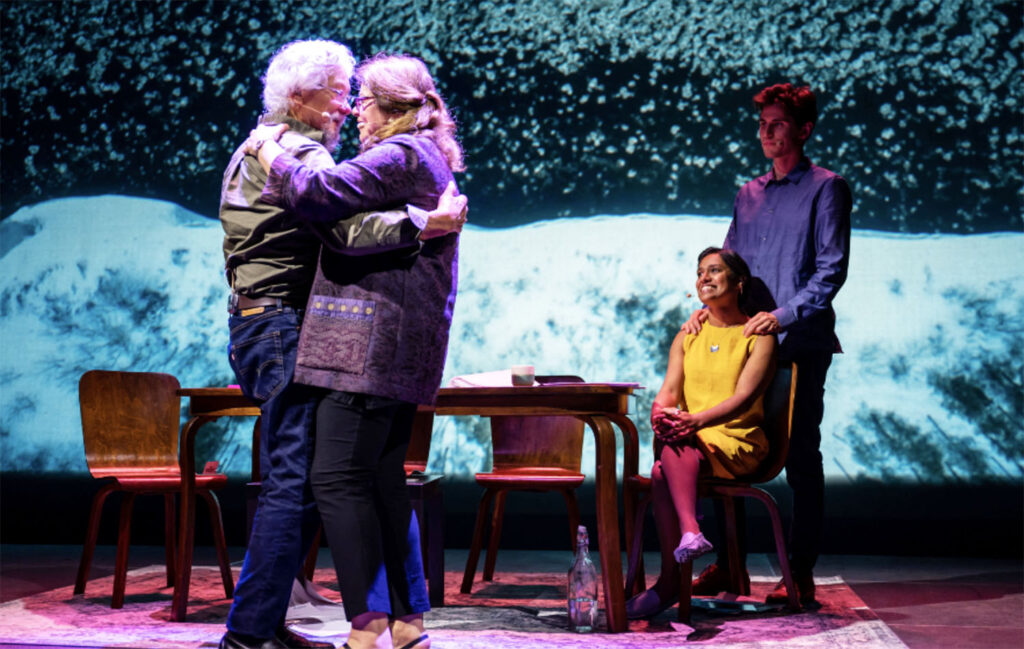
Two of the world’s most respected sustainability leaders, Drs. David Suzuki and Tara Cullis, combined to create a powerful and profound play, What You Won’t Do For Love. It’s an expansive, exploratory autobiographical performance about their global environmental activism and relationship over 50 years.
An entirely new dynamic is incorporated as it reveals how their lives became intertwined with those of a younger couple who encouraged the creation of the play and acted in the original performances. The couple, who ultimately married, are co-creator and associate director Miriam Fernandes (played by Michelle Mohammed in this show) and co-producer and director Sturla Alvsvåg (played by Jeff Erving).
Suzuki is the long-time, beloved and award-winning host of both a popular Canadian Broadcasting TV show and radio program, as well as a dedicated environmental activist, scientist and author of 55 books. He’s been featured several times in our newsletter.
He was certainly captivating – personable and charming while remaining honest (at times brutally) about the crises younger generations are facing. A standout contribution from him came near the close of the play, in the form of a transcendentalist poem from his 13-year-old self. Over lush scenes filmed on Quadra Island in British Columbia, his younger self speaks of birds, trees, air (a favorite topic of Suzuki’s) and the changing of the seasons. Now 91, the callback to his adolescence also reinforced the notion of a life lived in awe of the natural world.
From the beginning, however, I was most enraptured by his wife and costar, Dr. Tara Cullis. She taught literature and writing at Harvard and is an award-winning author in her own right. She has been organizing charitable work seemingly her whole life, including founding the David Suzuki Foundation, and is particularly notable for her work with indigenous peoples and First Nations. She has been adopted and named by the Haida, Gitga’at, Heiltsuk and Nam’gis people.
The introduction to the tearful journey we embarked on brought the 4 cast members to recreate the conversations they had over many years to ultimately write the play. Fernandes described reaching out to Suzuki by email about a possible collaboration and her subsequent delight when he responded. I would come to learn that David and Tara replying to correspondence of all sorts has been a constant throughout their lives. That might seem like a normal task, unless you receive more than 20,000 letters.
David and Tara ask whether they will have to memorize their lines, what the play will be about, and who will play their parts.The audience learns that what we will be watching is essentially the truth – of the last several decades for one couple and the past 8 or so years for the other – presented through conversations, pictures and video, and even dance.
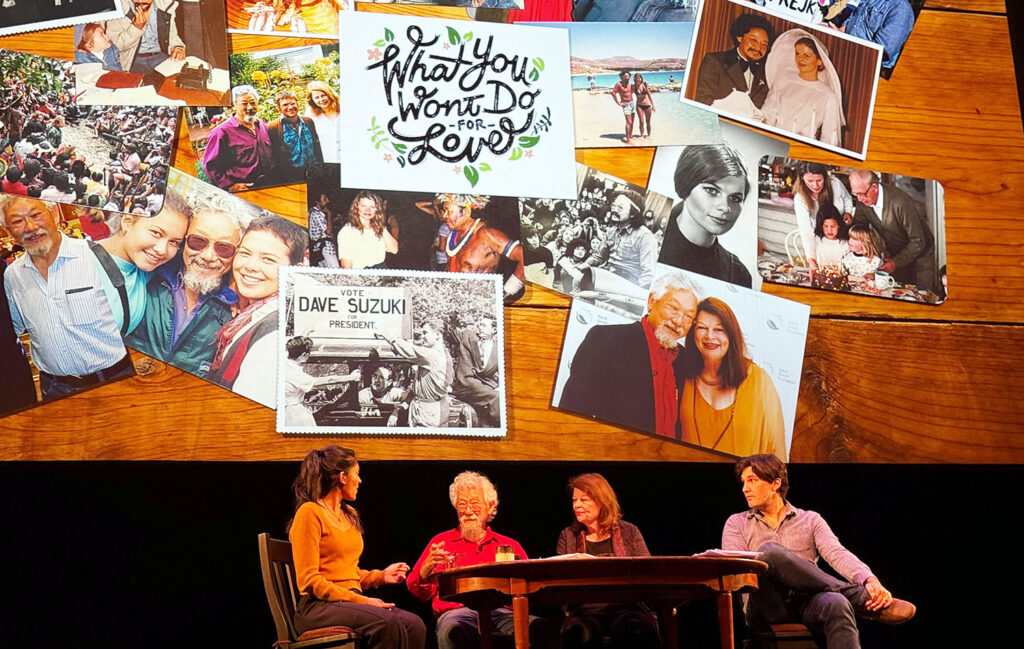
Tara got the biggest laughs as the play began to unfold. With an air of childlike wonder about the whole affair, she repeats that she had never acted before, then asks whether she could wear an Elizabethan gown for her performance. She recounts how she met her husband watching him give a lecture at Carleton University – a meeting borne of her decision to be proactive about finding a partner instead of just acquiescing to whichever man was most persistent at a given time.
She speaks about her PhD thesis in comparative literature: the growing chasm between science and art in 20th century literature and links this to the difference between left-brain and right-brain thinking, between logic and feeling, reasoning and emotion. As a long-time reader, I was just happy we were talking about Nietzsche.
It’s soon evident that the very format of the newest “Suzuki project” all goes back to Cullis. It’s art as a means of story-telling, a way of bringing us together and integrating the different aspects of our natures.
Nietzsche comes up, incidentally, because of Tara’s take on the oft-quoted “God is dead” line from his work The Gay Science. She, from her comparative literature background, recommended replacing “God” with “nature”, an especially heartbreaking observation when she reads the quote in its entirety.
God is dead. God remains dead. And we have killed him. How shall we comfort ourselves, the murderers of all murderers? What was holiest and mightiest of all that the world has yet owned has bled to death under our knives: who will wipe this blood off us? What water is there for us to clean ourselves? What festivals of atonement, what sacred games shall we have to invent? Is not the greatness of this deed too great for us? Must we ourselves not become gods simply to appear worthy of it?
This may already seem depressing for a play with love as its primary driver, but we’re just getting started. Sadness is an inevitability when you’re dealing with the subject of the natural world, and what we have done to it. Cullis and Suzuki are certainly no stranger to the feeling, clawing out victories for environmental causes against unmovable forces: Hostile governments. Men with machine guns. The selfishness of late-stage, unchecked capitalism.
Even the wins can be fleeting. The pair tell the story of the formation of the David Suzuki Foundation (DSF) which was, according to both, all Tara’s idea. It’s a beautiful beginning, involving handwritten missives to fans of Suzuki’s shows and more initial donations than either of them ever dreamt.
One project, which involved stopping the construction of harmful infrastructure in the Amazon, led to Tara picking up Portuguese because, in her words, “somebody needed to.” The DSF, with the help of close indigenous allies, was able to delay construction. They celebrated this huge victory. However, they poignantly reveal 30 years later the project was brought back and completed.
They reflect this seems to happen too often, as part of what they sarcastically call the “global housekeeping” cycle. Tara riffs on the word “housekeeping,” pointing to the undervaluing of domestic and historically female labor, listing ways a mother or caretaker contributes to their communities. But if a monetary valuation can’t be put on those contributions, the economic system doesn’t value them, considering them worthless. Housekeeping means working and working just to keep things the same, and “environmentalism is global housekeeping.”
Family, whether it’s built from scratch or found, biological or otherwise, is a featured theme throughout. I’ve found that some generational messaging in family themed media – like the importance of successors and the sacred bond between parents and their children – that may appeal to older audiences can feel outworn to younger ones, many of whom are seriously contemplating not having children.
The climate landscape faced by a child in 1960, 70, or 80 varies significantly from today, and much has already been lost that we cannot get back. I also give What You Won’t Do For Love kudos for presenting a more nuanced perspective in this area.
Some of this is due to the presence of the younger duo. Fernandes confides, in an intimate conversation set in David and Tara’s home while the audience listens in, that she is not sure whether she can bring children into such a scarred world. Her husband, meanwhile, is confident that he wants them.

But it’s not just the addition of a younger perspective that lends nuance. David recounts a moment where he held two of his young grandchildren in his arms and couldn’t stop himself from crying in despair. Tara affirms that he was distraught. Indeed, both of them openly acknowledge experiencing depression in turns. I felt the sincerity from both of them, in the same way I can almost feel the watery breeze on my skin from the lush footage captured in British Columbia.
Suzuki makes at least five references to his own death by the conclusion of the play. He mentions the earth hitting several climate tipping points and all we have already lost. Tara adds that “It’s too late” would be the perfect tombstone inscription for him. You would call it bleak, if not for his joyful demeanor and the obvious devotion between him and his wife. There is so much delight as David and Tara share their stories and we watch them dance together, first on screen at Quadra Island, and then on stage.
Following an extremely long standing ovation, there was a 20-minute question period. I took the opportunity to observe the crowd, noting the particular quirks and habits that make Minnesotans, and the people of the Twin Cities, who they are. For example, the organizer of a Buckthorn Removal Singles Club, a particularly problematic invasive species in Minnesota, gave his organization a shoutout.
I love these kinds of panels, whether for an author or playwright, for the chance to listen to people who have just experienced the exact thing I have, but interpreted it in a way entirely their own. It’s a rare chance to peek into somebody else’s internal world.
Suzuki just might agree with me. Community engagement and connection is the main goal of his foray into the world of theater: “I hope that the experience of being in a theatre, with your neighbours and community, listening to our stories, inspires people to take action on their local, community level. This is where the change needs to happen now. We can’t wait for politicians to save us – they’re too tied up in politics and economics, and the climate can’t wait.”
Given that this was the final stop on their tour, there is some consolation for those of you who would like to experience this uplifting and troubling play. The good news is that it will be coming out as a film.