By Alliance Intern Eleanor Hulan
Two of the world’s most respected sustainability leaders, Drs. David Suzuki and Tara Cullis, combined to create a powerful and profound play, What You Won’t Do For Love. It’s an expansive, exploratory autobiographical performance about their global environmental activism and relationship over 50 years.
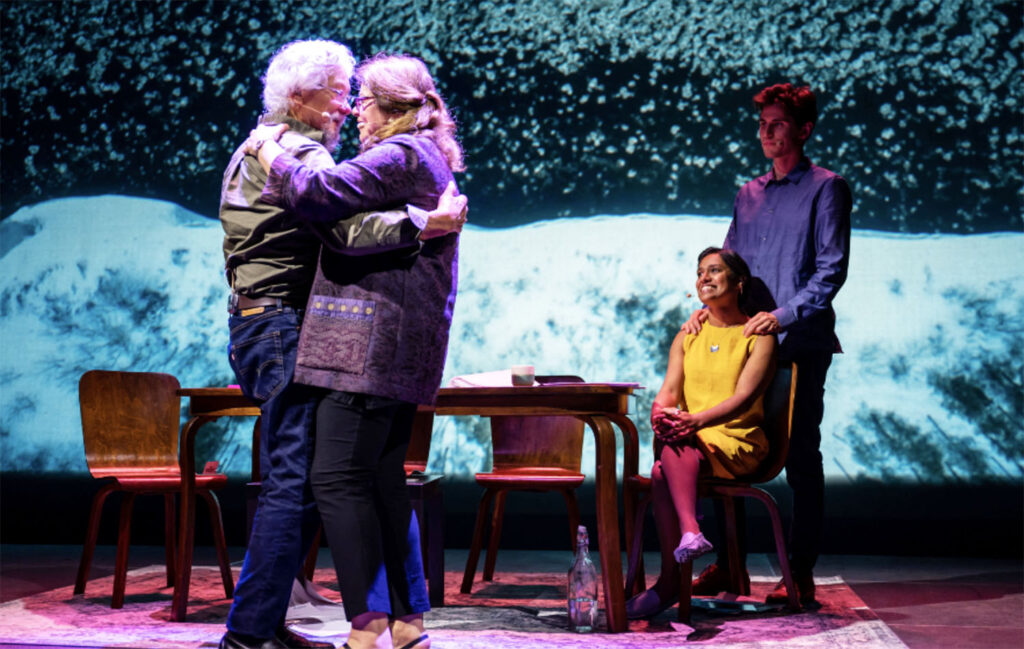
An entirely new dynamic is incorporated as it reveals how their lives became intertwined with those of a younger couple who encouraged the creation of the play and acted in the original performances. The couple, who ultimately married, are co-creator and associate director Miriam Fernandes (played by Michelle Mohammed in this show) and co-producer and director Sturla Alvsvåg (played by Jeff Erving).
Suzuki is the long-time, beloved and award-winning host of both a popular Canadian Broadcasting TV show and radio program, as well as a dedicated environmental activist, scientist and author of 55 books. He’s been featured several times in our newsletter.
He was certainly captivating – personable and charming while remaining honest (at times brutally) about the crises younger generations are facing. A standout contribution from him came near the close of the play, in the form of a transcendentalist poem from his 13-year-old self. Over lush scenes filmed on Quadra Island in British Columbia, his younger self speaks of birds, trees, air (a favorite topic of Suzuki’s) and the changing of the seasons. Now 91, the callback to his adolescence also reinforced the notion of a life lived in awe of the natural world.
From the beginning, however, I was most enraptured by his wife and costar, Dr. Tara Cullis. She taught literature and writing at Harvard and is an award-winning author in her own right. She has been organizing charitable work seemingly her whole life, including founding the David Suzuki Foundation, and is particularly notable for her work with indigenous peoples and First Nations. She has been adopted and named by the Haida, Gitga’at, Heiltsuk and Nam’gis people.
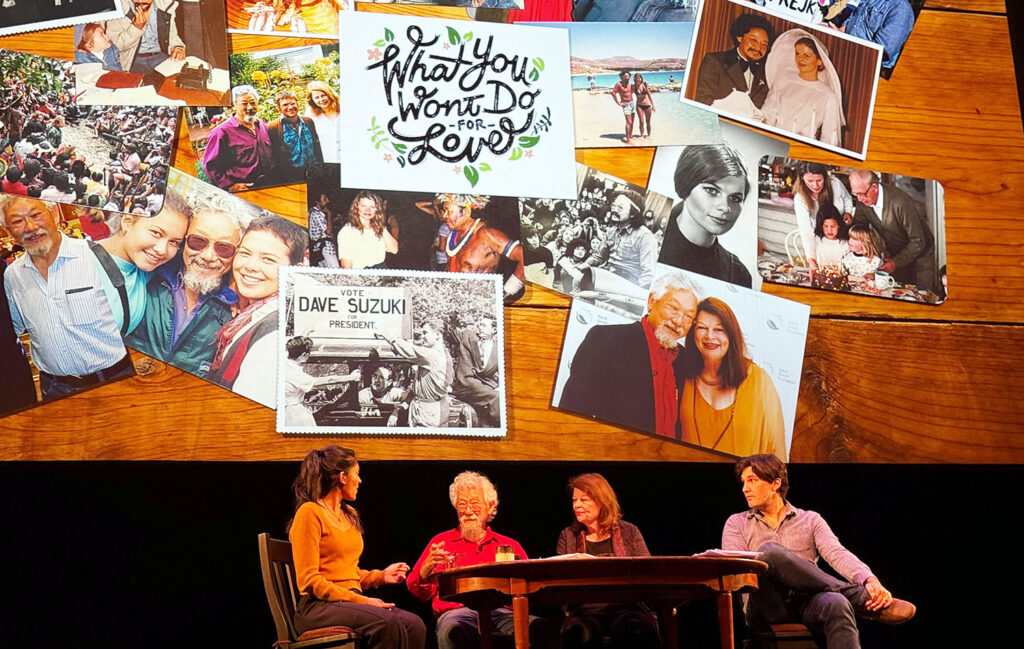
The introduction to the tearful journey we embarked on brought the 4 cast members to recreate the conversations they had over many years to ultimately write the play. Fernandes described reaching out to Suzuki by email about a possible collaboration and her subsequent delight when he responded. I would come to learn that David and Tara replying to correspondence of all sorts has been a constant throughout their lives. That might seem like a normal task, unless you receive more than 20,000 letters.
David and Tara ask whether they will have to memorize their lines, what the play will be about, and who will play their parts.The audience learns that what we will be watching is essentially the truth – of the last several decades for one couple and the past 8 or so years for the other – presented through conversations, pictures and video, and even dance.