
By Alliance Intern Eleanor Hulan
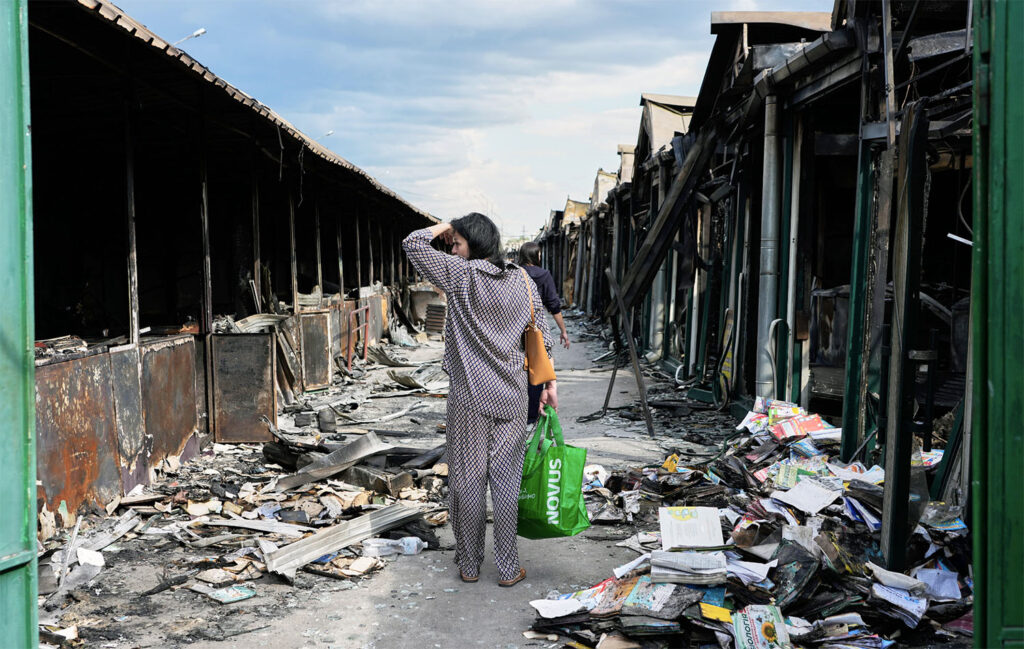
This summer, Russia destroyed more than 13 million Ukrainian books in targeted strikes, bringing about fires that raged for days at a time. Missile targets included printing presses, schools and the textbooks within, and smaller publishing houses that specifically publish local authors. The Ukrainian cultural minister, Tetiana Berezhna, called this brutality part of a “systematic attack on Ukrainian culture”.
I am wary of interjecting my own experiences into a tragedy with a scope I cannot imagine. But I can see the fire. I can hear the crackling pages. And I mourn for the lives lost in an unjust war with ever mounting death tolls.
I also mourn for those pages that will never be read again. Some, like textbooks, can be reprinted, but texts from smaller, independent publishers may be lost forever. And, as defense costs continue to mount, replacing books will probably not be first on the priority list.
While strikes on hospitals, railroads and critical military infrastructure may be more strategically damaging, the psychological cost of the loss of literature may ultimately prove just as dangerous for the future of Ukraine.
We’ve Created our Own Versions of Destruction by Fire
Some less incandescent version of Russia’s firebombing is being carried out internally in Western countries from Germany to the United States. Targets include Black culture, feminist literature, queer studies, and works on disability. But the gutting also extends beyond so-called “woke” topics, sometimes all the way to liberal arts studies as a whole.
Hans-Thomas Tillschneider, a figure in the increasingly popular far-right AfD party in Germany, called university humanities classes “legitimising whores” of social change. It’s an irony of many far right leaders that they speak in such a profane, violent manner, while advocating for censorship for purported moral reasons.
The party would like to see “wokeness” removed from elementary curriculums, and more about German achievements added in. Turkey and other countries have either proposed or already succeeded in making regressive curriculum changes.
It is a tactic we’ve seen the world over. Information is suppressed. Censorship abounds. History is rewritten.
Declining Literacy Rates in Both Children and Adults Underscore a Rising Problem
I’ve often heard people, typically older, lamenting the unique ignorances of Gen Z and A. It’s true that recent testing shows, globally, that literacy rates in adolescents have declined by about a grade level. Early indicators are also showing that Big Tech’s stranglehold on adolescents has not exactly helped their cognition.
Reading for pleasure is down significantly. The same study shows that percentage of US 9-year-olds who say they read books for pleasure has gone from around 60% in the 1990s to 37% in 2026.
But it’s not just children. The OECD also records lower literacy rates in the adult population, less ability to decode complex texts, and, when asked, less pleasure in reading overall.
I don’t think it’s fair to place the blame for this downward trend entirely on Mark Zuckerberg. We’re living through an era where learning is systematically under attack.
Book Bans: Encouraging Cultural Hegemony and Dissuading Independent Thought
PEN America recorded 12,000 book bans in 2025, the majority in Texas and Florida, which together comprise over 15% of the US population. The importance of significantly restricting the educational life of this many citizens cannot be overstated.
Since 2021, 23,000 books have been banned. Right wing states have passed laws forbidding teaching on race, gender, and certain negative aspects of American history.
In North Carolina, students and parents succeeded in getting Between the World and Me by Ta-Nehisi Coates banned from an English teacher’s curriculum. (While we’re here, I highly recommend reading this book). To advocate for this ban, a student said “I am pretty sure a teacher talking about systemic racism is illegal in South Carolina,” and they weren’t wrong.
The American Library Association reported that 40% of the titles challenged in 2025, which also recorded the highest number of bans in one year, represent the lived experiences of LGBTQIA+ people and people of color.
Texas has also succeeded in removing library books from the shelves. A decision in 1996 meant Texas, Mississippi and Louisiana previously had no latitude to ban books from libraries based on personal feelings.
But this decision was overturned in May of last year. One of the defendants calling for the overturn included a local judge, a Trump appointee, who argued that public libraries public bear no responsibility to “affirmatively assist other people’s efforts to obtain or access books.”
But that’s what libraries have been doing since the concept came about.
Just as Ukraine Has Been Doing for Years on End, We Must Fight Back

It has become more difficult to still think of ourselves as global citizens as isolationist attitudes persist. Some residents see the US as uniquely malevolent. some as uniquely superior. But we are still part of a much larger world. The growth of far-right movements, the suppression of information and the eroding of democracy are all taking place worldwide.
Books and art are not just a small piece of the puzzle, they’re foundational. Russia’s moves to destroy repositories of Ukrainian knowledge demonstrate the strategic importance of the written word. We cannot forget this importance, lest our ignorance be used against us.
The Ukrainian Cultural Minister said, “We are critical infrastructure, because we shape the future — we work on education, on culture. We work to preserve history.” Libraries and public education do the same. These institutions are more important to protect than ever.