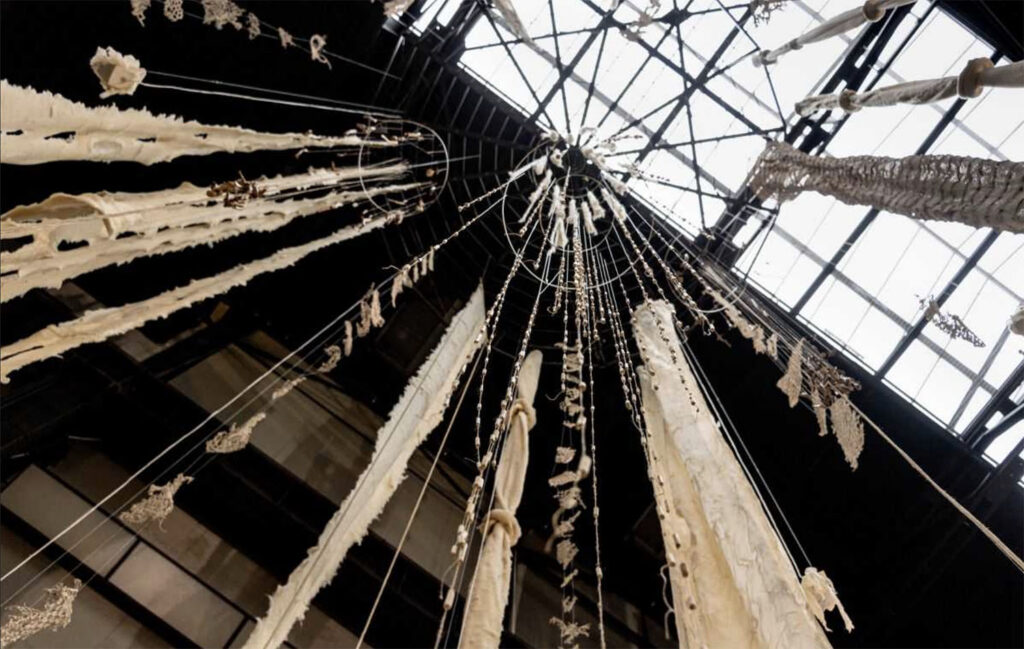
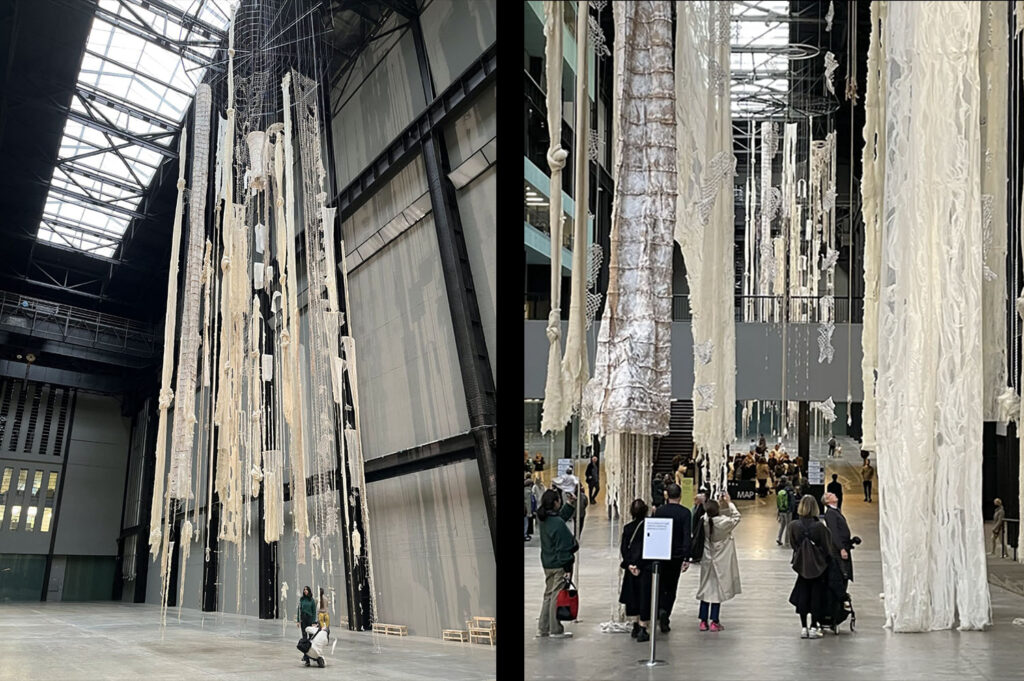
Brain Forest Quipu Installation by Cecilia Vicuña at Tate Modern, 2022. Credit: Tate Photography (Sonal Bakrania)
By Alliance Communications Coordinator Amy Durr
It’s a pleasure in honor of Earth Month 2026 to contemplate the visceral art of Cecilia Vicuña. Born in Chile and exiled to London in her early 20s, “Vicuña’s multidisciplinary practice frequently addresses themes of ecological art, feminist perspectives, and decolonial practices, often drawing on Indigenous cultural heritage. Her work encompasses performance, poetry, drawing, painting, video, and installations, including…renowned quipus,” according to Heni News.
What a lush, generous and collaborative universe Vicuña’s art generates and reflects. Vicuña describes the origin of her signature quipus:
“Quipu means knot in Quechua. It is a system of encoding information through knots that are so complex that can convey as much information as the Phoenician alphabet, which is the writing system that we use in the West. So this system of encoding information in knots was used for almost 5,000 years in the Andes, until the conquest.
“I suppose when I met the quipu I was flabbergasted at the notion that this incredible system existed and it had been taken away from us. Erased from our cultural memory. A knot is a gathering of energy and if you extend that to the history of five thousand years of quipu making, everybody who has ever been connected to the quipu is connected to a field of knowledge, a field of love and understanding.”
– Cecilia Vicuña, Your Rage is Your Gold
Viewing Cecilia Vicuña’s installation is an uncomfortable experience. The two works are so tall and slender you’ll have to seriously crane your neck, practically falling over backwards in order to see and study them…It mirrors the issues this work is meant to address: climate change, deforestation and violence against indigenous peoples. Credit: Mark Westall (left), London Art Round Up (right)
This reminded me of our discussion last month about epigenetics, the genetic transfer of trauma from previous generations. As we transfer trauma to new generations, we can also transfer love and understanding in the form of art, ecological knowledge and positive cultural memories.
All Art is Political, Especially When You’re Exiled
It’s amazing how Vicuña imbued her art, all created far from home, with her indigenous knowledge, love for the natural world and deep caring. Here are her words as she talks about her long career in Your Rage is Your Gold, a 7-minute video produced by the Tate Modern:
“I have had a political orientation in my art from day one, but that is because I was a teenager when I read, I understood, that the life of this planet was endangered.
“My name is Cecilia Vicuña. I’m a poet and artist. I was born in Chile. When I first came to London, I arrived in September of 1972. I got a grant from the British Council to come study here. I was here for just a few months when the military coup occurred in Chile and therefore I did not return.
“So that’s how I became an exile. Since then I have never been able to live in Chile again.”
Precarity as a Liminal Artistic Space
“I call my art Arte Precario – precarious art. Precarious because it disappears. Because it’s fragile. Because it’s vulnerable. Whether it is a twig, a stone, a piece of metal, a piece of plastic – everything to me feels alive with history, with decay, with the potential and possibility of dying, of dissolving, and for me that is its beauty.”
“It is a conscious choice on my part to focus on what is dying and disappearance. The reason for that is that when I was young everything that was decaying was regenerating life.
I encourage you, as part of your celebration of Earth Month, to watch the Tate Modern video on Cecilia Vicuña and listen to her talk about her art. She is absolutely luminous. Credit: Tate Modern
“Now we have created the terminal death. A new kind of death in this planet. A kind of death that did not exist, that was not created by a biological process. This new kind of death continues to be my focus, and that’s why all the materials that you see are shredded, falling apart and about to become nothing. Because that is what may happen to us as a species very soon unless we wake up in time to protect the ecosystems that we are destroying right now.”
I find myself returning to that phrase — terminal death. Do we have a word or even a concept for things that never come back? Vicuña has been making art about this for fifty years. We are just now beginning to live into her understanding and vision.
Art as Collaboration and Co-Creation
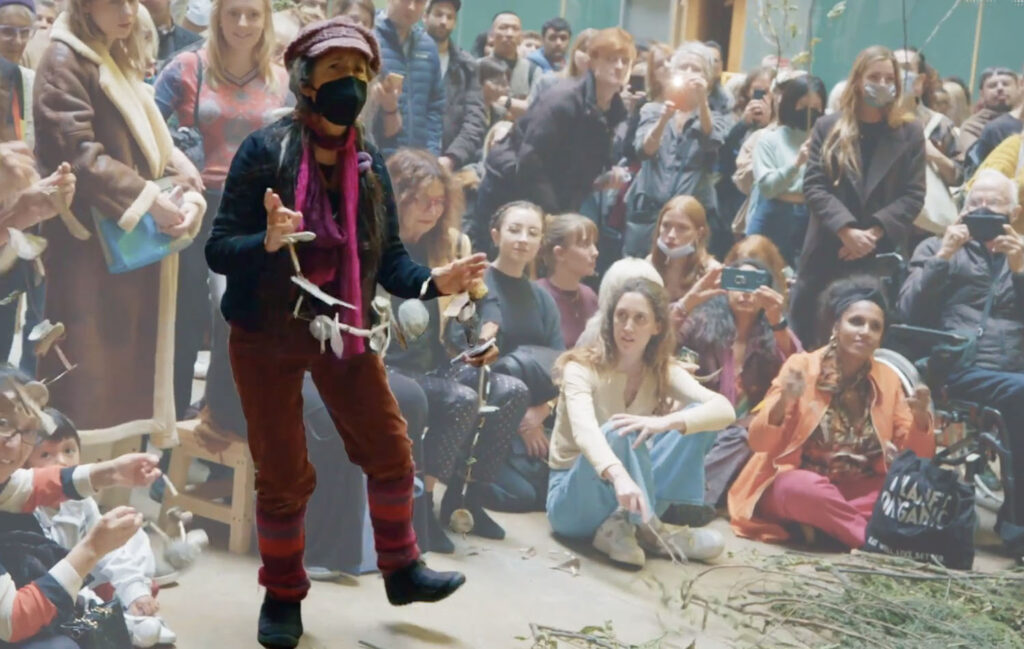
“I began collaborating to create my art in the 60s. The audience and I become co-creators. It is an invitation for us to share so that we can acknowledge that experience is not just our own experience. Experience is what we experience together and that creates many points of view. And many points of view have to be aware of each other so that there is no oppression or domination.”
It’s unusual for an artist to invite the audience as a co-creator. But at the Alliance we feel that co-creation is at the heart of true sustainability. And yes, Vicuña is so right that the process invites multiple points of view – especially differences – that are essential to us respecting the value of every person. We all matter and if we leave people out they may react and counter our efforts. We need to engage everyone in the process of co-creating a thriving world that works for all.
Cecilia Vicuña creating collaborative art from branches, shells and string with a large group at the Tate Modern. We highlighted her as she delightedly engages the diverse audience. Credit: Tate Modern
She continues, “And as time goes by it becomes more and more of a necessity [for the work to include] as many people as possible, because we have to reconnect and rebuild and grow with the notion that we have to work together. And why is that? Not only for the survival of our species but most of all because it’s joyful. Because it’s fun and it’s beautiful and it’s delightful.”
What a gift. An artist inviting us in our total diversity and points of view to come together as a joyful, fun, beautiful and delightful act!
Rage Can Transform the World
“The most beautiful experience that I have had is that when the social uprising began in Chile in October of 2019, people began picking up certain lines of my poetry and my [series of] Palabrarmas. The line that was repeated most often and that people converted it into banners was ‘Tu rabia es to oro,’ which means ‘Your rage is your gold.’”
Because it is a rage that’s coming from love, from love for each other. Love for the earth. And it is this rage that can transform the world. The rage of love, of pure love.”
Something loosens when I read those words. Rage doesn’t go away — but it finds its source, and the source is love. That’s worth holding onto.
A New Collaborative Quipu for Earth Month 2026
On April 29, 2026, a new exhibition titled Cecilia Vicuña – El glaciar ido (The vanished glacier / Il ghiacciaio scomparso), will open at the Castello di Rivoli Museo d’Arte Contemporanea in Rivoli, Italy with a new commission conceived by Vicuña. Specifically designed for the building’s longitudinal spaces, the work is envisioned by the artist as a quipu acostado, a horizontal installation suspended at multiple heights.
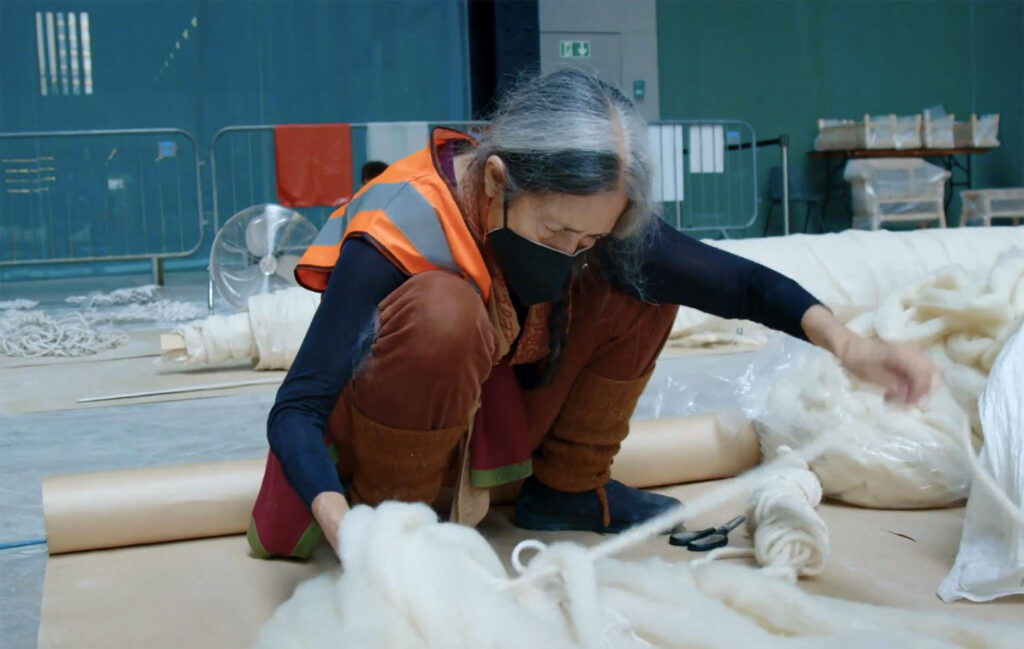
“Vicuña’s contemporary quipus become immersive environmental installations that traverse space and time,” shares Castello. “To create them, the artist favors raw, unprocessed wool, which she unwinds and assembles, producing striking aerial architectures.”
“In the Manica Lunga of the Castello, the new quipu will serve as an evocative presence of the passage of time—both human and geological—of the movement of natural elements such as wind and water, and of the transience of human presence in relation to the environment,” they continue.
“The artist wishes for local communities to contribute by collecting small residual natural materials—such as wood fragments, stones, shells, feathers, or other elements—from nearby waterways and bodies of water, including the Dora Riparia and the Avigliana Lakes. The participatory nature of the quipu is a fundamental element that allows the work to become a ‘weaver’ of people and places.”
“The relationship with water is sought by Vicuña as a memory of the ancient glaciers, now extinct, that once dominated the landscape of the Valle di Susa, where the Castello is located.”
I keep returning to that phrase: a memory of the ancient glaciers, now extinct. Vicuña is making a quipu for what cannot come back. And she’s asking us to bring something from the water’s edge to add to it. That feels like exactly the right gesture for this moment.
The Many Gifts of Cecilia Vicuña
Vicuña is a true global treasure and a reminder of the key role artists play in our society and the need to incorporate all forms of art in sustainability.
Cecilia Vicuña has spent fifty years making art from what’s disappearing — from exile, from ecological grief, from the ruins of what colonization erased. That she is still making it, still inviting us in, still asking us to bring something from the water’s edge feels like an act of faith I want to be worthy of.