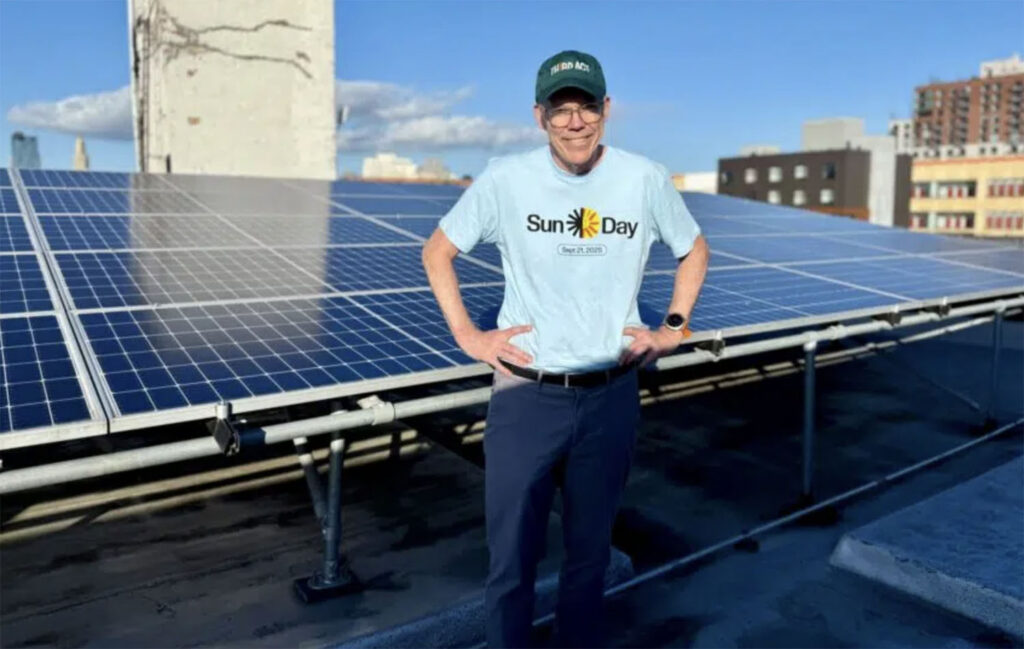
In his latest book, Here Comes the Sun: A Last Chance for the Climate and a Fresh Chance for Civilization, McKibben calls for solar and wind energy, which he argues are much more disruptive and revolutionary in the global energy market than we’ve previously understood. Credit: Peace Corps Connect
By Alliance Communications Coordinator Amy Durr
Reading books on the climate emergency might be a trauma response for me — not so different from doom scrolling. How bad are things? Is there any hope? What can we actually do?
Honestly I read them for the bad news, and there’s always plenty of it. Any book worth its salt will make sure of that. And then there are the rare ones that do something different. Bill McKibben’s Here Comes the Sun is one of those. I really wish every single person would read this book, and get as excited as I am about the promise of solar and wind renewables.
Activist, organizer and author Bill McKibben makes a strong argument that solar, wind, and hydro (more limited by geography) are real contenders for turning things around, in a justice-centered way. He has a calm, practical voice which builds trust with his audience. He’s been talking about climate for more than thirty-five years, and he’s been remarkably prescient.
What surprised me most is how naturally his argument falls into the questions we ask here every week — about health, equity, and what it looks like to be genuinely kind to the future.
Breathing Easier — The Health Case for Solar and Wind
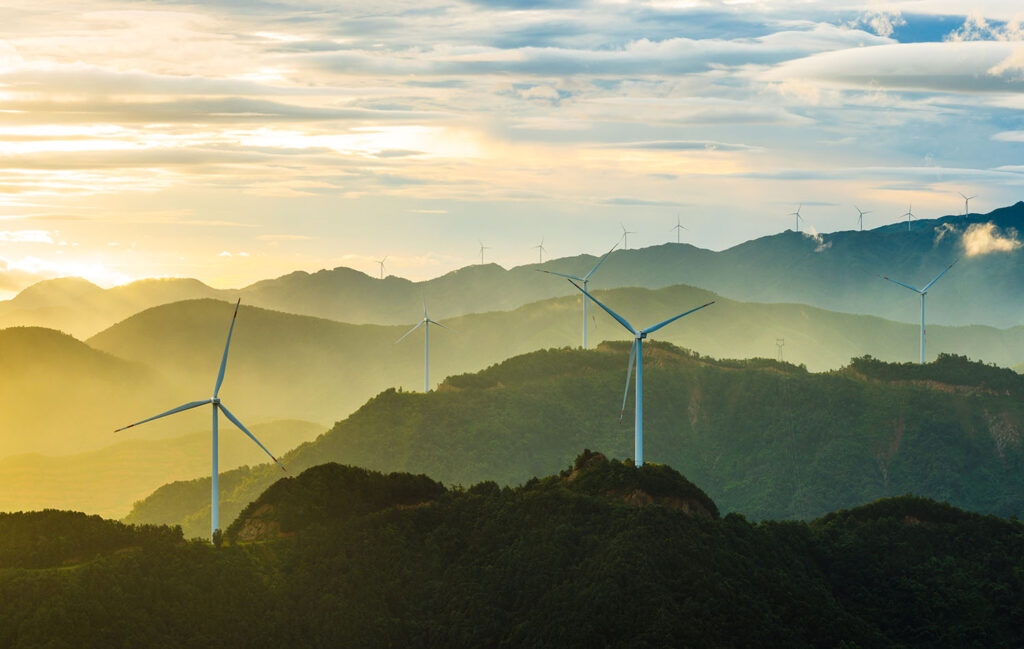
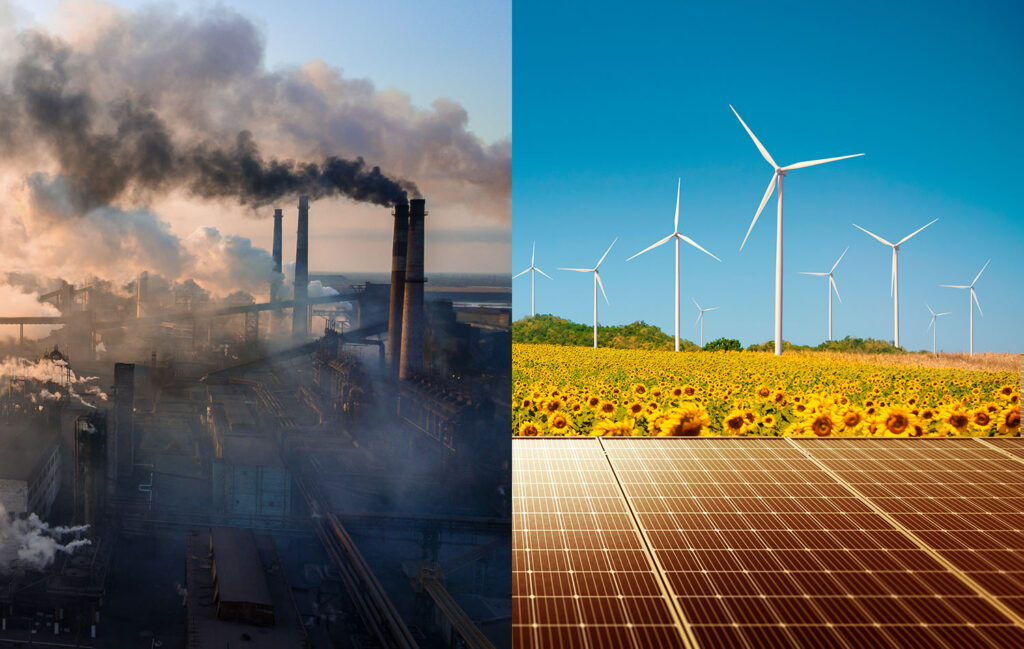
We can remind ourselves of healthy, clean, toxic-free air when we see wind turbines. Credit: ABCDstock
“In this fight, the solar panel and the wind turbine are both the crucial machines and also the symbols of potential liberation. And in true Hollywood fashion, our liberation and our destruction are arriving at precisely the same time, offering us a remarkable choice.
“Everything is going wrong, except this one big thing. Our species, at what feels like a very dark moment, can take a giant leap into the light. Of the sun.” – Bill McKibben
Fossil fuels don’t just warm the planet — they also poison lungs, disproportionately in communities of color and near industrial corridors. McKibben reminds us that nine million people a year die — one death in five — from breathing the particulates spewed out by fossil fuel combustion.
The burden is not shared equally. Children in low-income neighborhoods and communities of color are far more likely to live near highways, power plants and industrial facilities — and to pay for it with their lungs. Asthma rates, cardiovascular disease, even preterm births track closely with proximity to fossil fuel infrastructure.
But here’s what the research is beginning to show: where the transition to clean energy happens, health outcomes improve. Not eventually, not theoretically — measurably, and relatively quickly. The solar panel and the wind turbine are not just climate tools. They are public health interventions.
The Sun Doesn’t Send a Bill — Solar as Equity
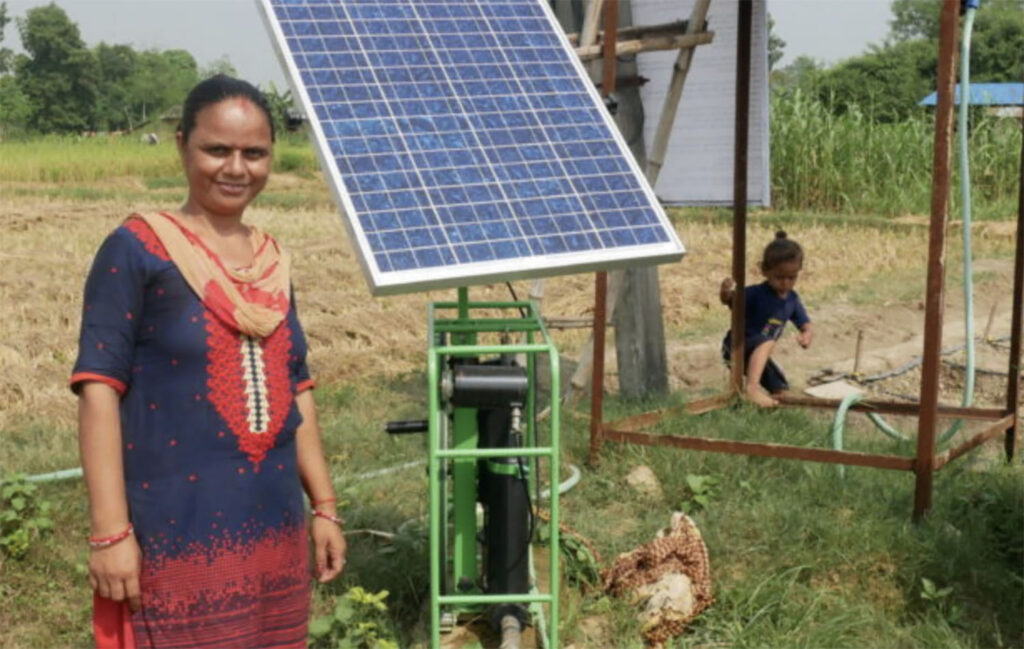
Agrovoltaics (or agrisolar) is the dual-use practice of co-locating solar panels with agricultural production on the same land. It maximizes land efficiency by allowing for grazing, crop growth, or pollinator habitats under or between elevated solar panels. This idea is very exciting to me. Credit: IKEA Foundation
“…energy from the sun is not just cheap. It’s also diffuse, available everywhere instead of concentrated in a few places. And that prefigures a different world with a more localized and more humane geopolitics; indeed, the sun works more reliably toward the equator, which could allow the redress of some of earth’s great inequities.” – Bill McKibben
McKibben’s central argument is that solar energy is now the cheapest power on Earth — which reframes it from an elite lifestyle choice to a justice issue. Who gets access to cheap, clean energy and who doesn’t?
With access to sun and wind, and solar panels from China whose price continues to fall, the calculus changes entirely. Energy abundance is no longer available only to wealthy nations or zip codes. For the first time in the history of industrial civilization, the poorest communities on earth have access to the same energy source as the richest.
McKibben knows that access to technology doesn’t automatically mean justice. Policy, financing and political will still determine who benefits first and who waits. Community solar programs, which allow renters and low-income households to subscribe to shared solar arrays, lowering your energy costs from what a utility would charge, are one promising model.
My state of Pennsylvania isn’t offering community solar yet, but that just gives me something to work toward. The urban areas of Alliance’s home state of Minnesota are densely covered with opportunity.
The underlying shift is real and historic: when the fuel is sunlight, no one can own it, monopolize it, or weaponize it. Our star has been rising over the poorest villages and the wealthiest cities for four and a half billion years, making no distinctions whatsoever. The sun doesn’t send a bill.
Learning to Say Yes — Kindness as Climate Practice
Although the sight of solar panels and wind turbines may not be ideal for some people, they sure are in contrast to fossil fuel energy. Can we learn to see the beauty in harvesting electrons? Credit: noppadon
“Sometimes I think the state motto of my beloved Vermont (‘Freedom and Unity’) should be amended to ‘Change Anything You Want Once I’m Dead.’ Many of us, especially perhaps those in rural areas, are used to the way the landscape looks right now, and even the obvious danger of climate change and the obvious appeal of power from the sun can’t override our knee-jerk reaction: “I don’t want to look at that.”
A solar farm or a wind turbine reads in our mind as ‘industrial,’ and since we have a deeply pastoral sense of the landscape, even if we’re making our living from staring at screens, that strikes us as obnoxious.” – Bill McKibben
McKibben names environmentalists who were good at saying no to bad projects as the ones who now need to learn to say yes to good ones. The same instinct that made activists effective — protective, resistant, suspicious of change — can become an obstacle when the change being proposed is actually the point. Saying yes is its own skill. And it may be the most important one we need to learn right now.
This is where climate and kindness converge. Kindness, in the way we mean it here, is not politeness or accommodation. This ecological kindness is an active, generous turning toward what is needed. It is the willingness to be inconvenienced by a wind turbine on the horizon if it means a child in an industrial corridor breathes easier. It is the capacity to tolerate change, even unwelcome change, in service of something larger than our own comfort.
We need to also recognize that farmers are struggling to stay afloat and wind and solar can provide them essential income to keep farming, avoiding a subdivision being built.
McKibben calls this learning to say yes. We might also call it becoming more fully human. Creating a world of sustainability calls on us to find a balance between ecological soundness, economic viability, social justice and humaneness, embodying our highest values in terms of how we treat people, animals and the planet. It’s not always easy, but we should shift to considering all of these elements. Each of us can always listen and respond in kinder ways.
Instead of our society of self-interest and immediate gratification, we might want to consider the Native American concept of Seven Generations, in which every decision should take into account its impact seven generations from now. This can lead us into an ethic that values all of Mother Earth into the future.
The solar transition will not happen without kindness and a larger worldview. Neither, perhaps, will anything else worth doing.
Here Comes the Sun – Our Star
An amazing, beautiful photo of the sun’s upper atmosphere, or corona, in ultraviolet light. Credit: ESA & NASA/Solar Orbiter/EUI Team
“We are, quite suddenly, in a world-changing moment. We have a project, one with a deadline — indeed, we can echo JFK who said that ‘before the decade is out’ we would land a man on the moon and return him to Earth. Before our decade is out, we have to break the back of the fossil fuel system. We have to land the sun on the earth.” – Bill McKibben
Some at the Alliance feel we should avoid violent language like “break the back,” because it breeds more violence and triggers an equal or greater reaction from those whose vested interests are threatened. Others of us feel that the control and dominance of the fossil fuel industry is so great they need to be strongly countered.
But all of us at the Alliance agree with Buckminster Fuller’s idea that ultimately, the best way to counter a bad system is to create a better one to replace it. And we also agree with renewable energy icon Amory Lovins who said that the Stone Age didn’t end because they ran out of stones. Renewable energy will make fossil fuels extinct.
Bill’s “world-changing moment” is not a metaphor for someday. McKibben is talking about this decade — the one we are living in right now. The technology exists. The economics have shifted. What remains is the human part: the will, the yes, the willingness to let the landscape change so the future can arrive.
We can actually change the world together by looking to the sun. The oldest light there is. Still arriving. Still free.