
By Alliance President Terry Gips
Can you imagine living without time, where every minute isn’t controlled by The Clock?
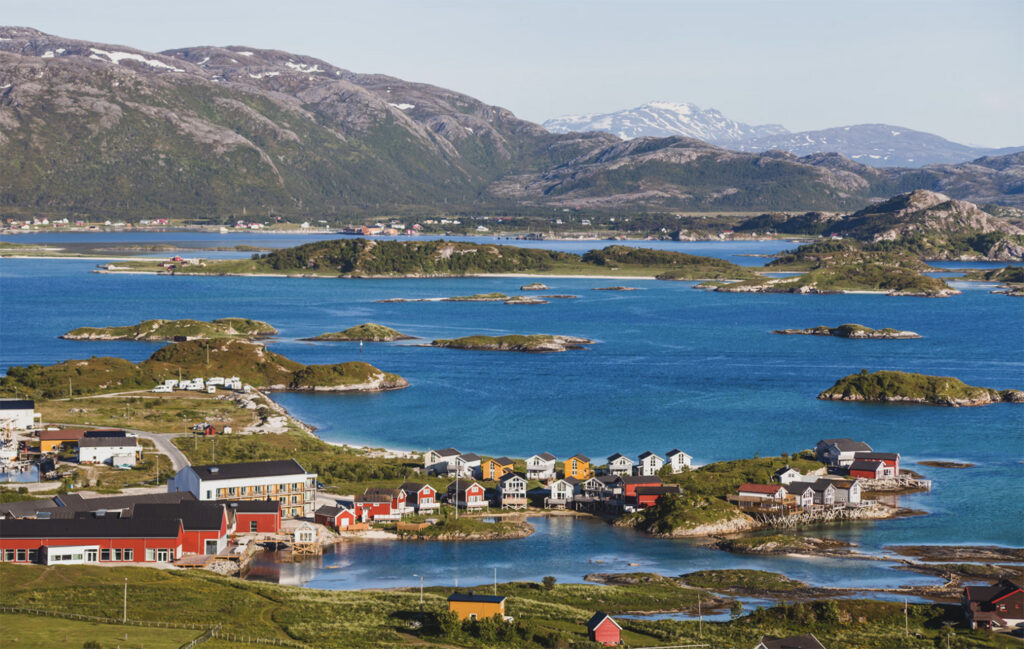
Thanks to Facebook, we went on a journey to such a land far away and above the Arctic Circle, an island in Norway. We want to take you there with this 2-minute video so that you can fully experience what it might feel like, while also sharing a June 20, 2019 update to the original article by The Guardian newspaper. Here are excerpts from the original article, followed by some important thoughts we have about all of it.
“All over the world, people are characterised by stress and depression,” Kjell Ove Hveding, the leader of the campaign on the island, west of Tromsø and inside the Arctic circle, told the Norwegian public broadcaster NRK.
“In many cases this can be linked to the feeling of being trapped by the clock. We will be a time-free zone where everyone can live their lives to the fullest … Our goal is to provide full flexibility, 24/7. If you want to cut the lawn at 4 am, then you can do it.”
“The islanders, whose main sources of income are tourism and fishing, are calling for formal opening hours to be abolished and people to be allowed to ‘do what we want, when we want’ – although children will still have to go to school, Hveding said.”
“Sommarøy spends November to January in darkness, but in summer residents know that when the sun rises on 18 May, it will not set again until 26 July.”
“It’s constant daylight,” Hveding said on the campaign’s Facebook page. “If you want to paint your house at 2am, it’s OK. If we want to take a swim at 4am, we will.”
The residents added: “Here we enjoy every minute of the midnight sun, and yes, a coffee with friends on the beach at 2 am is a normal thing.”
But Is All of This Too Good to Be True?
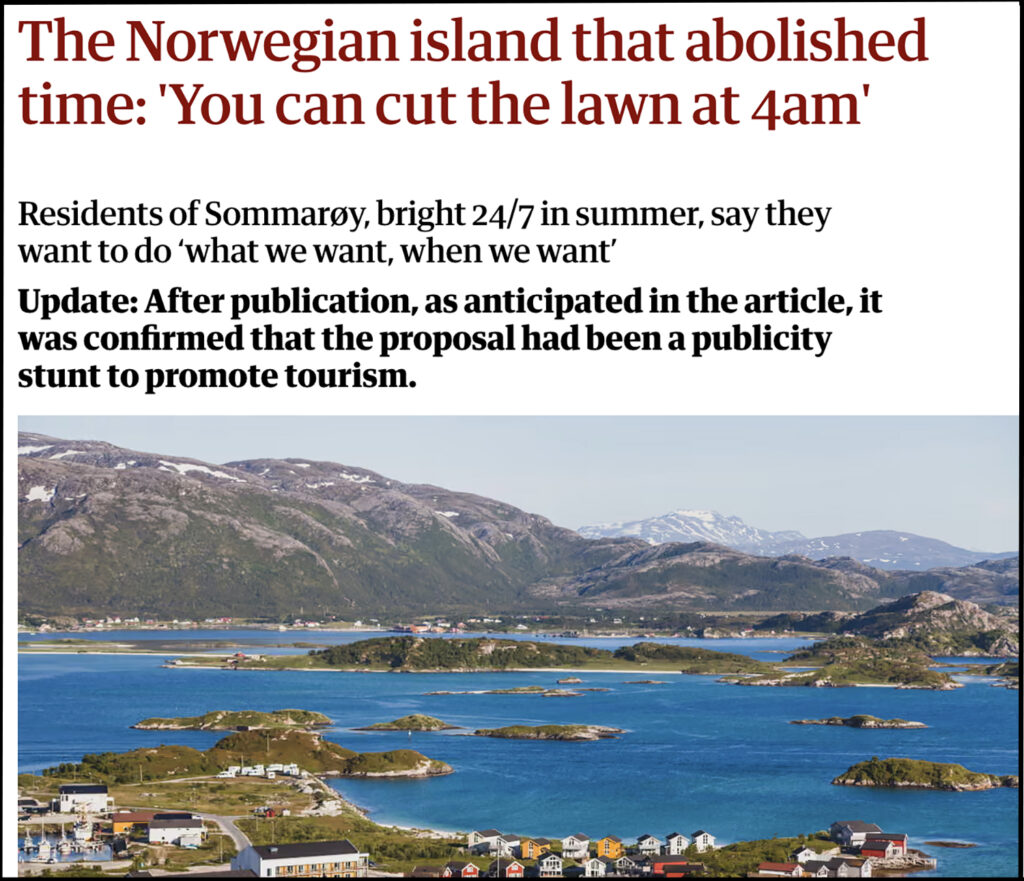
Yes. The Guardian updated their original piece and said, “Update: After publication, as anticipated in the article, it was confirmed that the proposal had been a publicity stunt to promote tourism.”
In their update, The Guardian explained, “Tourism officials told NRK they suspected the campaign was mainly a clever ploy to attract more summer visitors, but a philosophy professor has hailed it as an intriguing idea.”
The Guardian interviewed Truls Egil Wyller of the Norwegian University of Science and Technology in Trondheim: “It’s a fascinating concept.” Society had been ruled by the clock “and so disciplined in a very special way” only for the past two centuries.
“Before that, you worked mostly as long as it was necessary, you ate food when you were hungry and you laid down when you were tired. In modern society, everything we do is controlled by the pace of the clock, from the moment we get up.”
He said residents of Sommarøy would not find life without time particularly easy. “I’m not going to say it’s impossible to pull a whole island out of the global clock,” he told the broadcaster. “But it does sound very difficult.”
Is Having Such a Vision Helpful or Harmful?
We were originally enthralled by the uplifting 2-minute video and it inspired us to want to go and explore the possibility of creating such a society. But, when it came time to write this article, our hearts and hopes were dashed when we realized we and The Guardian had been fooled. This raises a number of issues we feel are worthy of contemplation.
First, is it helpful to experience a mind-expanding concept even if it’s not real? We could debate that back and forth. On one hand, we are so mired in an ever-darkening world, so can a fanciful island remind us about who we really are and what may matter most in our lives?
I’ll never forget the line and image from the video when the narrator asks, “How would you like to open your door and be surrounded by the Northern Lights?” I almost cried as I realized these transformative wonders are available for free and should be part of our daily lives.
In some ways, this took me back to La La Land, where I will always dream of the two lovers dancing in the stars and on the Seine. I am grateful to have those deeply romantic moments and their accompanying music in my body as a possibility for true life.
Second, it’s concerning that we’ve been fooled again. Way before AI reared its ugly head of fakes, someone created a totally believable yet unbelievable video that even fooled the trusted Guardian newspaper. More than ever, we’re experiencing a massive integrity deficit so pieces like this squash our hopes and make us more skeptical.
Third, this is a sober reminder of the new world we are entering into as bad actors easily create a range of fake news that they can send out freely and instantaneously to confuse and stoke division. It’s at times like this that we need trusted mainstream news sources to sort fact from fiction. However, it’s not so simple.
Even CNN – one of the most prestigious, fact-based media outlets – had to take more than two hours to review and pour over the first available video from the murder of Renee Good before they could verify it was not fake. What will happen amidst a major event when CNN and other news outlets are flooded with critical, time-sensitive videos? Who will assure us they’re real?
Fourth and finally, these questions about truth-telling are more urgent than ever given corporate media takeovers and government deception. We now have a White House that feels free to doctor actual photographs of Minneapolis protestors like Nekima Levy Armstrong to suit their purposes and see nothing wrong with it.
Worse still, Jeff Bezos just laid off one-third of the Washington Post staff (including most of the climate reporters) and has removed liberal commentators from their opinion pages.
Meanwhile, centibillionaire media mogul and Trump sycophant Larry Ellison and his son David, now owners of Paramount Skydance, installed right-wing Bari Weiss as the head of CBS News. She has already blocked a sensitive 60 Minutes piece and brought about fundamental, rightward shifts in CBS coverage, causing consternation and departures among staff.
What’s next? Ellison is seeking to buy CNN, which would threaten another one of the most trusted journalistic sources. Few Americans are aware about these scary shifts and what they mean for our ability to have any sense of what’s true or not, what’s up and what’s down. I hope this is a helpful wake-up call.
Who could have imagined that a tiny, timeless island above the Arctic Circle could trigger such a big discussion? I’d like to hear your thoughts about the vision, skullduggery and questions this island has raised.
We are connected to the clock at all times !
I wonder if classes at schools were more flexible. It might be nice to see your family at home during a break of a few hours. Children and parents would learn how to spend this precious time in a significant way such as knitting at home together, participate in non violent discussions, invite the grand parents toshare a meal, etc,
I like what you wrote !